Dark Entries is an independent Belgian music webzine with a focus on dark sounds. The webzine itself is completely in Dutch and can be found at www.darkentries.be. This blog was created with the intention to have an additional online place where our editors can post their English articles.
Music from the depths of hell, slowly rising in a lava flow with the intoxicating scent of steaming sulfur exuding from the cracks, gradually engulfing the earth, sowing death and destruction, leaving only jet-black cold ashes behind it ...' This is the way we started our review of 'Tempus Edax Rerum', the new record from JOHN 3:16.Since we were overwhelmed and intrigued by this rare knot of sounds, we decided to send some questions to mastermind Philippe Gerber.
Hello Philippe.We are very impressed with your new record 'Tempus Edax Rerum'.Are you satisfied with this new work?
Hi Xavier.Thank you for your kind words.I am aware that it is a record that is difficult to approach.The songs are long and contain lots of unique sounds, which correspond to different music styles at the same time.I believe I'm satisfied, and that with some distance this will prove to be a sustainable work, because it is very personal.
We can see a connection between 'Visions of the Hereafter' in 2012 and 'Tempus Edax Rerum' in 2020, but we also see differences.How has your sound evolved since 2012?
'Visions of the Hereafter' was also a very personal album. For this record, I started from a very specific theme - the concepts of Paradise, Hell and Purgatory in the monotheistic religions and their representation in the arts, especially in painting - and I had the global dynamics of the record already in my head. The titles of the opus and of the songs were also already fixed before I started working on the music. I have used the same approach for 'Tempus Edax Rerum'. I had the title in mind and the notion of a collection of movements that follow each other long before I recorded the very first note.
What is different, however, is the production. I do believe I have progressed in eight years, especially with regard to the sound of the drums. I have been working for Ruben Nava / Music Junkies in Los Angeles for three years as a composer of music for trailers, films, TV series, et cetera. Ruben is a music director with an incredible musical culture. He has helped me to get out of my comfort zone, especially with regard to anything rhythmic. Of course, that has reflected on my production work with JOHN 3:16. 'Visions of the Hereafter' presented very different rhythmic productions. There is more cohesion on 'Tempus Edax Rerum': the soundscapes of the keys merge with the sound of the guitars. It is sometimes impossible for the listener to perceive all the sounds. I've been lucky enough to work with Carolyn O'Neill, who put her voice and a number of instruments on a song. She also participated in the composing of 'Visions of the Hereafter'.
You present 'Tempus Edax Rerum' as the sequel to 'Visions of the Hereafter'. However, you have published a lot of work in the last eight years, between the two albums. Why is it a sequel to this 2012 record?
'Tempus Edax Rerum' is officially the second album from JOHN 3:16. It is the coherent sequel to 'Visions of the Hereafter'. It is true that I have released a significant number of records: records in collaboration with Mark Harris and Anthony Donovan, a compilation of b-sides, EPs and singles (including '200 Million Horsemen' and 'Sodom & Gomorrah'), a live bootleg and I even had the chance to re-release 'Visions of the Hereafter' on cassette (with the first EP 'John 3:16' as a bonus) via Cruel Nature Recordings from England. I recently made a remix of NIN ('In This Twilight') together with the Belgian group Be The Hammer, with whom another collaboration project is ongoing. All these releases between 'Visions of the Hereafter' and 'Tempus Edax Rerum' helped me to forge the sound you hear now. I've taken the time to edit the sound of the guitars in the studio, I've gone to the trouble of playing some drum parts live, and I've even dusted off some of my analog keyboards. These eight years were essential to find a new direction and a fresh identity.
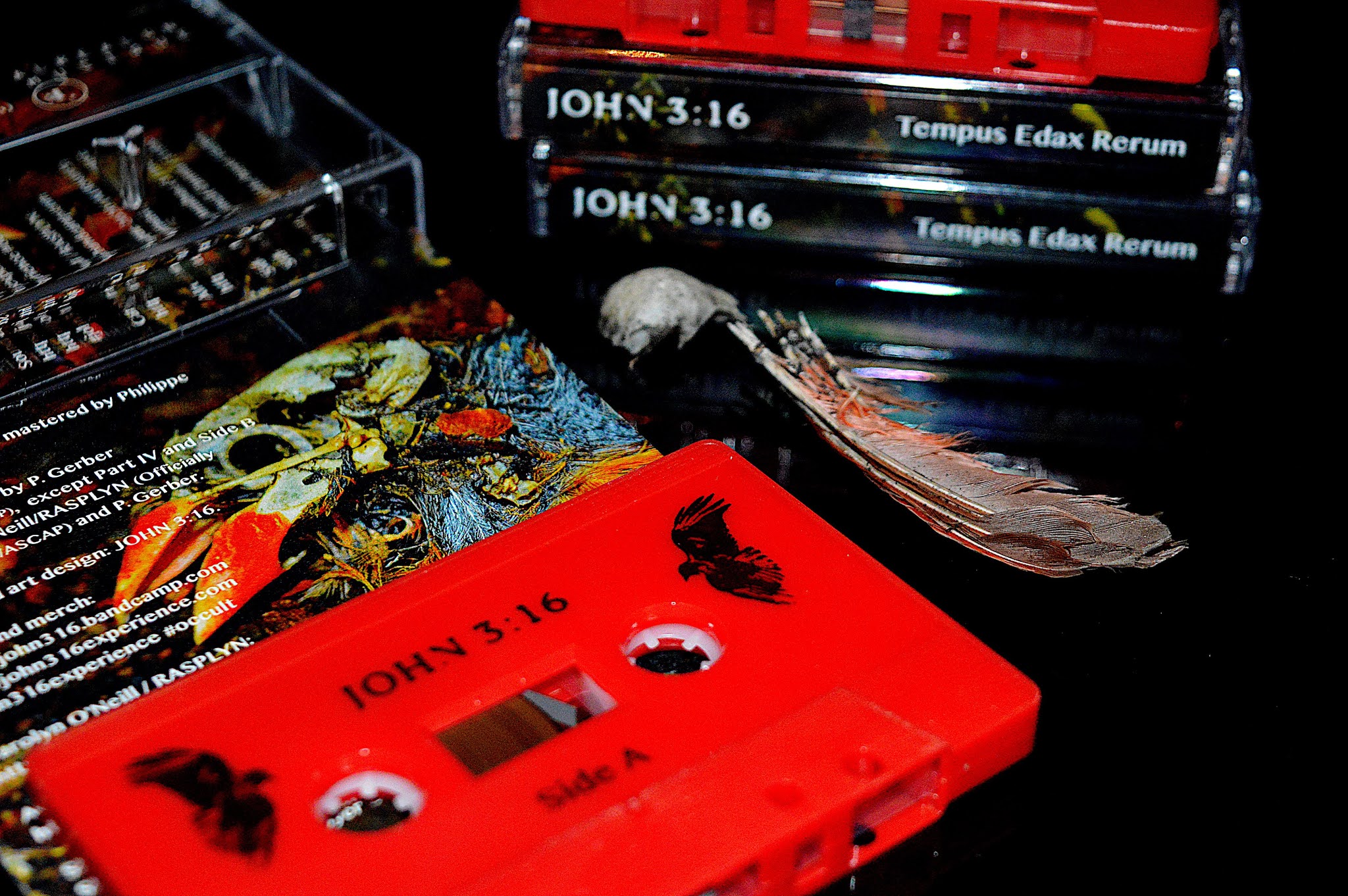
You made a special and limited version of the record in which you transformed your songs - five tracks on the digital release - into two pieces on cassette.What important decisions did you have to make to make that happen?
I composed a set of 30 songs for 'Tempus Edax Rerum', resulting in over 10 hours of recordings.For the cassette version, I wanted to do something unique by adding two unreleased tracks hidden in two long tracks: 'Mors omnibus' and 'Mors vincit omnia'.It was not that difficult to do as 'Tempus Edax Rerum' is a set of coherent movements which production is homogeneous from the first to the last note.
The songs on your cassette are called 'Mors omnibus' (death to everything) and 'Mors vincit omnia' (death will overcome everything). Death seems to be a prominent theme on your new record. Why?
I've lived in Pennsylvania since 2013. I'm close to Philadelphia, but I'm in a part of Pennsylvania that's still pretty wild. This contact with nature - in a quiet place, in a sense - is necessary for me to compose. Part of where I live is lost in a forest where deer, fox, vultures, eagles and others apprehend each other on a daily basis. I regularly come across animal remains at various stages of decomposition. In a way, that started to touch me, and it is there that the concept of the record was born. The art used for the digital version and for the cassette is composed of photos I have taken over the years, which is a means for me to pay tribute to these graceful creatures.
The religious references seem to have disappeared. In a previous interview, you told us that religion is the main theme of JOHN 3:16. Is this still the case?
'Tempus Edax Rerum' deals with a universal notion - that of a beginning and an end to everything - that is linked in a way to 'Visions of the Hereafter'. In Christianity, for example, the notion of immortality is not natural to humans. Even if one wants to believe in an afterlife, death is an indispensable step that one must accept in a serene way. In Hinduism, death is only suffering, and that justifies the various rebirths until one has reached one's true Self. So, to answer your question: yes, JOHN 3:16 is mainly inspired by religion in the broadest sense of the word. It is mainly occultism in religions that is the focus of attention.
It took you eight years to make a sequel to 'Visions of the Hereafter'.When will the sequel come?
I am working on the next full-length, called 'The Pact'.The theme is fixed.It will be based on the Faust myth, mainly influenced by Goethe's written tragedy.The record should be released in 2022 or 2023. The label has yet to be confirmed.The artwork is already finished.The Mexican artist Nestor Avalos has been responsible for that.He has worked with such bands as Moonspell, Mercyless, Iscariot and others.One song is already in the final mix phase.I will put an extract on my page in 2021.
"De la musique venue des profondeurs de l'enfer, montant lentement dans une coulée de lave avec l'odeur enivrante du soufre fumant qui s'échappe des fissures, engloutissant progressivement la terre, semant la mort et la destruction, ne laissant derrière elle que des cendres froides d'un noir profond ... '' C’est comme ça que nous avons commencé notre critique de «Tempus Edax Rerum», le nouveau disque de JOHN 3:16. Et parce que nous étions étonnés - le tonnerre est l'un des sons qui semblent sortir de vos enceintes en écoutant le disque - et intrigués par ce broui de sons rare, nous avons décidé d'envoyer quelques questions à Philippe Gerber, l’auteur de l’œuvre.
Bonjour Philippe. Nous sommes très impressionnés par ton nouveau disque 'Tempus Edax Rerum'. Es-tu satisfait par ta nouvelle œuvre ?
Bonjour Xavier, merci pour tes mots. Je me rends surtout compte que c’est un album qui n’est pas facile à approcher. Les titres sont longs et plein de sonorités particulières, et qui correspondent à plusieurs styles en même temps. Je pense que je suis satisfait, et qu’avec le recul, c'est une œuvre qui va durer, car elle est très personnelle.
Nous voyons une continuation entre 'Visions of the Hereafter' en 2012 et 'Tempus Edax Rerum' en 2020. Mais nous voyons aussi des différences. Comment ton son a-t-il évolué depuis 2012 ?
‘Visions of The Hereafter’ est aussi un album très personnel. Pour ce dernier, je suis parti d’une thématique spécifique - les concepts de Paradis, Enfer et Purgatoire dans les religions monothéistes, la représentation de ces concepts dans l’art et en particulier la peinture - et j’avais déjà en tête la dynamique globale de l'album. Le nom de l’opus et les titres étaient également quelque chose qui avaient été définis avant même que je ne commence à travailler sur la musique. J’ai eu la même approche pour ‘Tempus Edax Rerum’. J’ai eu d’abord en tête le titre et la notion d’ensemble de mouvements qui se succèdent bien avant d’avoir enregistré la toute première note.
Ce qui diffère par contre, c’est la production. Je pense avoir progressé en huit ans, surtout au niveau des sons de batterie. Depuis trois ans, je travaille pour Ruben Nava / Music Junkies basé à Los Angeles, en tant que compositeur pour musique de trailers, films, séries TV, etc. Ruben est un directeur musical qui a une culture musicale incroyable. Il m’a aidé à sortir de ma zone de confort, en particulier pour tout ce qui est rythmique. Ça a naturellement déteint sur mon travail de production dans le cadre de JOHN 3:16. ‘Visions of The Hereafter’ présentaient des morceaux aux productions rythmiques bien différentes. Il y a plus de cohésion sur ‘Tempus Edax Rerum’ : les nappes de claviers se mélangent aux sons de guitares. Il est parfois même impossible pour l’auditeur de discerner ces sons. J’ai eu la chance de pouvoir travailler avec Carolyn O’Neill (Rasplyn, Chicago) qui a posé sa voix et quelques instruments sur un titre. Elle avait également participé à la composition de ‘Visions of The Hereafter’.
Tu présentes 'Tempus Edax Rerum' comme la suite de 'Visions of the Hereafter'. Pourtant, tu as beaucoup sorti en ces huit années. Pourquoi est-ce une continuation du disque de 2012 ?
'Tempus Edax Rerum' est officiellement le second album de JOHN 3:16. C’est la suite cohérente de ‘Visions of The Hereafter. Il est vrai que j’ai sorti un nombre important d’albums (en collaboration avec Mark Harris et Anthony Donovan), un disque de B-sides, de EPs et singles (‘200 Million Horsemen’, ‘Sodom & Gomorrah’ entre autres), un bootleg live et j’ai même eu la chance de rééditer ‘Visions of The Hereafter’ (avec la premier EP ‘John 3:16’ en bonus) en version cassette via Cruel Nature Recordings (Angleterre). Récemment, j’ai produit un remix de NIN (In This Twilight) avec le groupe Belge Be The Hammer, avec lequel j’ai un projet de collaboration en cours.
Toutes ces sorties entre ‘Visions of The Hereafter’ et ‘Tempus Edax Rerum’ m’ont aidé à forger le son que tu peux entendre. J’ai pris le temps de travailler les sons de guitares en studio, j’ai fait l’effort de de jouer certaines parties de batterie en temps réel et j’ai même pris le temps de dépoussiérer certains de mes claviers analogues. Ces huit années ont été essentielles pour trouver une nouvelle direction et une identité neuve.
Tu as fait une version spéciale et limitée sur cassette ou tu as reconstruit tes morceaux - cinq morceaux sur la version digitale - en deux morceaux sur la cassette. Quelles décisions importantes as-tu dû prendre pour rendre ça possible ?
J’ai composé un ensemble de 30 titres pour ‘Tempus Edax Rerum’ - plus de 10 heures d’enregistrement. Pour la version cassette, je voulais présenter quelque chose d’unique en ajoutant deux titres inédits dissimulés dans deux longs titres 'Mors omnibus' et 'Mors vincit omnia'. Il m’a été facile de le faire, puisque ‘Tempus Edax Rerum’ est un ensemble de mouvements cohérents dont la production est homogène de la première à la dernière note.
Les morceaux sur la cassette s'appellent 'Mors omnibus' (mors à tout) et 'Mors vincit omnia' (la mort vainc tout le monde). La mort est un sujet prédominant sur ton nouveau disque, non. Pourquoi ?
Je vis en Pennsylvanie depuis 2013. Je suis proche de Philadelphia, mais je suis dans une partie de la Pennsylvanie qui reste assez sauvage. Ce contact avec la nature - au calme en quelque sorte - m’est nécessaire pour composer. Une partie dans laquelle je vis est perdue dans une forêt ou cerfs, renards, vautours, aigles, etc. se côtoient au quotidien. Assez fréquemment, je tombe à la rencontre de cadavres d’animaux à différents stades de putréfaction. Cela a commencé à m’affecter en un sens, et c’est là qu’est né le concept de l’album. L’art utilisé pour la version digitale et pour la cassette est composé de photos que j’ai prises au cours des années, une manière pour moi de rendre hommage à ces gracieuses créatures.
Par contre, les références religieuses ont semblé disparaître. Tu nous avais dit dans une interview précédente que la religion était un thème principal dans JOHN 3:16. Est-ce encore le cas ?
‘Tempus Edax Rerum’ traite d’une notion universelle (celle d’un commencement et d’une fin à tout), qui est connectée en un sens à ‘Visions of The Hereafter’. En Christianisme par exemple, la notion d’immortalité n’est pas naturelle à l’Homme. Même s’il l'on veut croire à un après, la mort est une étape inéluctable qu’il faut accepter de manière sereine. En Hindouisme, la mort n’est que souffrance, et c’est ce qui justifie les renaissances multiples jusqu’à atteindre le Soi véritable. Donc pour répondre à ta question, oui, JOHN 3:16 est primordialement inspiré par la religion au sens large. C’est l’occultisme dans les religions qui est surtout le centre d’attention.
Tu as mis 8 ans à produire une suite à 'Visions of the Hereafter'. A quand la suite ?
Je suis en train de travailler sur le prochain long intitulé ‘The Pact’. La thématique est définie, ce sera basé sur le mythe de Faust, majoritairement sur la tragédie écrite par Goethe. L’album devrait sortir en 2022 ou en 2023, le label est encore à confirmer. L’artwork est déjà prêt, c’est l’artiste Mexican Nestor Avalos qui s’en est chargé. Il a travaillé avec des groupes tels que Moonspell, Mercyless, Iscariot, etc. Un titre est en cours de mixage final. Je posterai un extrait sur mes pages en 2021.
Mark Harris is active
as a solo ambient artist and JOHN 3:16 is the project of Philippe Gerber
creating apocalyptic fields of sound. On ‘Victory Over The Sun’ - the name
comes from the first futurist opera from 1913 - they have joined up to make something
that we described as ‘a steamroller of sound that rolls over you, at times
soothing and extremely interesting.’ We heard out both artists on this
remarkable and successful cooperation.
Hi Philippe and Mark. You just released a collaboration
CD under the name ‘Victory Over The Sun’. Why did you choose that title for
your CD?
Mark Harris:
It came about when working on our first track together, which became the title
track. It was way more conventional as we were still finding our feet on the
project. Then Philippe said: ‘hold on I'm doing it again’, and he proceeded to
rip it all to bits and to add a mind shredding guitar part... It was a classic
light bulb moment and I emailed him back saying: ‘Wow!! Sound's like you
“punched a hole in the sun”’. And Philippe was like ‘That's it. That's what we
call the project.” I've always been into the Russian Constructivists and always
loved the set designs for the 1913 Constructivist opera ‘Victory over the Sun’ created
by Malevich. It caused a riot when performed. So we went with that.
Philippe Gerber:
From the start, I knew the title and the album concept would have to be
connected to cosmology. I envisioned what we would come up with together
musically speaking before we started recording anything. I dreamed of black holes,
dead stars and more. When Mark came up with the idea of naming our album
‘Victory Over The Sun’, I was excited. At the time, I was already working on
the new JOHN 3:16 album ‘The Sun Shall Be Turned Into Darkness, and The Moon
Into Blood...’ and it seemed like the perfect name for our work.
How did you meet and how did you decide to work
together on this project?
Mark Harris:
It was via soundcloud - Philippe's work kept on turning up in my feed and I
posted the odd comment that I really liked the apocalyptic feel to his work -
and Philippe was into what I was doing as well so we began exchanging CD's when
we had a release so it when from there. I had just released ‘In the forests_
the animals are moving’ on n5md, which used some live heavily processed
prepared tabletop guitar played by me... So I was kind of thinking of taking my
work in a harder, more aggressive route… and then as if by magic Philippe
emailed me and suggested we work together on a project...
Philippe Gerber:
I have been following the label n5md since it’s beginning in 2000. One of my
favorite artists on the label is Mark. He's one of the best ambient artists out
there. His albums are magical. I have a list of artists I want to work with
(most of them are dead now), and Mark is on it. When he agreed to work on
something after I got in touch with him, I knew we would come up with something
people would be excited about.
Mark wrote on his website: ‘It has pushed us both
outside our comfort zone and created something we would not have attempted
individually.’ How did you work?
Mark Harris:
Well, nearly all of my work is kind of ambient, kind of dark ambient, but
ambient non the less... And Philippe works at the outer reaches of mega intense
rock (for want of a better description)... Philippe (correct me if I'm wrong
here, Philippe) has a more intuitive, gutsy, in the moment way of working...
whereas I tend toward an intellectual, considered, SLOW way of working that
will listen to the same piece for months (literally) before making a tiny tweak...
I would send a studio improvisation to Philippe and literally within the week
he would send me 5+ tracks of guitar and drum parts as a response... It took a
while to process. Everything he did was unexpected but totally spot on...
Working with Philippe definitely changed the way I worked and altered the way I
look at music making...
Philippe Gerber:
For my solo albums, I usually start a song from scratch based on a beat, a
guitar riff or a sample. The way I worked with Mark was different. I had to sit
and listen to what he sent me before I could record guitar or bass parts. I had
to sing some of the parts to find the right melodies. I didn't write anything
down. For some of the songs, I recorded up to 30 harmonized guitar tracks. I
sent the best 5-6 ones to Mark.
What do you think are the requirements for a good
collaboration?
Mark Harris:
I think the main thing is working with someone who has a totally different
approach to you... otherwise you just end up producing more of the
same...
Philippe Gerber:
Mutual respect and musical maturity.
Mark, you make music with field recordings and
computers, and you are also active as a visual artist. Can you tell us more
about your art?
Mark Harris:
Well, I studied as a painter but always had a strong interest in systems and
process art. Which is how I found my way into music. In the early 2000's I
started producing generative animations (animations which run but will never
repeat). These gradually started to use audio - then audio only... I have
always been into systems music like Steve Riech, and English composers like
Michael Nyman and Gavin Bryars. And of course Brian Eno. That's how that
started, the last series of work I produced were based on automatic writing and
drawing - where you supposedly tap into the subconscious - and then ran though
3D modeling software. The result was painted by hand. There are some examples
on the website if you fancy a look...
Philippe, why wasn't the CD released through Alrealon
musique, the label of which you are one of the managers?
Philippe Gerber:
I'm trying to release my JOHN 3:16 albums on other labels. I'm trying to
separate both entities: Alrealon and JOHN 3:16. I want to reach a larger
audience by releasing my music on different labels. It's also hard to be managing
a label while promoting your own work. Little Crackd Rabbit Records did a great
job with the promo, I wouldn't have done it better. I'm also proud to be part
of their roster.
JOHN 3:16 was born with the concept of making music
with religious and biblical references. I can't find any on this CD. What are
your future plans with this project?
Philippe Gerber:
For me everything is connected to religion. Stephen Hawking has proved that
there is an existing link between the Universe and our concept of deity (yet to
be found). For me, ‘Victory Over The Sun’ with title tracks like ‘Requiem for
The Lost’ or ‘The Angry Moon’ has a Biblical tone in consonance with my
previous works. As JOHN 3:16, I'm still working on two releases coming up this
year. The first one is a CD compilation of B-sides I recorded the last ten
years as JOHN 3:16 (I can't believe I started the project in 2007). The second
one is the album untitled ‘The Sun Shall Be Turned Into Darkness, and The Moon
Into Blood...’ and tells the story of the Apocalypse as seen by John the
Apostle (Book of Revelation, A.D. 96). I started recording it in early 2016 and
it should be ready by the end of March (James Plotkin will be taking care of
the mastering). We are planning to record a new album with Mark later this
year. I'm really looking forward to it. I started a new collaboration with
Belgium-based artist Be The Hammer, it's something I'm excited about as well.
I'm hoping to play more shows this year too. I'm so busy with Alrealon and my
studio projects, it's hard to find time to go out there and play.
Mark, what are your plans for the future?
Mark Harris:
Well the next thing is a remix project put together by Bigo Twigetti and
Moderna Records - where a number of artists remix a track by the composer
Madeline Cocolas. I work full time as a graphic designer so I only have a week
off to produce something... which is a nightmare for someone who take months to
produce anything.... Philippe and me are planning a next release and are
looking to work with a cellist and violinist, so watch this space. Other
than that I've got the problem every other artist has: how to make a living from
doing something I love... if anyone has an answer please call me! I'm also
thinking of ditching computers and working with live instruments entirely. How
this will work? I have now idea, and as I got very very ill in 2015 and
suffered a stroke. I can't play guitar anymore this will definitely take a lot
of planning.... Philippe and I would ideally like to work together live (as we
have only worked via the internet up till now). The fact there is a large body
of water between us - I work in the UK and Phillippe is in the US - is not
helpful. We will be looking at playing a few festivals together, at how the
setup works and how we interact live. It would be interesting!