Posts tonen met het label Ahráyeph. Alle posts tonen

dinsdag 21 december 2021

25 YEARS OF AHRÁYEPH: Everything I do, right or wrong, is being determined by my autism

25 years, that's how long Ahráyeph has been around. Or rather: in 1996, the first demo of Crucifire, the predecessor of Ahráyeph, was released. In 2021 the ‘XXV’-E.P. was released by Ahráyeph, which had to celebrate a quarter of a century of music by Raf Ahráyeph – Raf Jansen for the friends. We thought this was a great opportunity to review the most important dates from this ‘prog-goth’ career with Raf. We had many questions, and Raf has always answered extensively and remarkably candidly. So it turned out to be a long, but very interesting interview.

1996: You record your first demo for Crucifire, a goth metal band which is a precursor for Ahráyeph. Tell me how that came about?

At that time, I used to live in an old convent, which also housed university students. Among others, Steven Zwaenepoel, now road manager for dEUS, lived there. In 1995, Jo, Crucifire’s bassist to be, got a room in Steven’s hallway for the duration of his nursing apprenticeship. We kept in touch afterwards and because he had told me of his band, Sarcastic, I went to a rehearsal of theirs in the Spring of 1996. They mostly played cover songs, like Therapy?’s ‘Teethgrinder’. I had already laid the initial foundations for Crucifire with a first demo, recorded on an analog four track back in 1995, and was now looking for a band. Jo, playing bass, and his buddies David and Peter were competent musicians, so I proposed to segue their band into mine.

I don’t remember why, but Peter wasn’t part of it initially, so we had a different guitar player for a while. When he failed to show, it turned out that Peter was interested after all. David moved from drums to keyboards and electronic percussion, because I had an amazing drummer in my buddy Geert, who - without wanting to diminish his drumming abilities - outclassed David on that instrument. But David had a lot more qualities: he had a much broader theoretical knowledge and was a multi-instrumentalist, so I really wanted to keep him in the band, even if we already had a keyboard player in Raf Corten, who I later took with me to Ancient Rites.

The six of us then started rehearsing and recorded a first, hideously sounding demo in October 1996. We did parts of that in our rehearsal space and in the loft I had moved to, which has been immortalised as ‘The White Square’. We had really decent recording gear, which is surprising for a fledgling band, but we made up for the lack of recording experience with enthusiasm, with all the hideously sounding consequences.


1996-1997: You start playing in the black metal band Ancient Rites. Is that the reason why Crucifire got sidetracked?

I have to adjust that timeline a bit: I’ve played in Ancient Rites for about six months that first time, from September 1996 till March 1997, with a one-off stand in gig in May, when Erik couldn’t make it to the concert. My addition to that band wasn’t the reason why Crucifire got sidetracked, though, because the band kept existing, albeit less and less as time went by, until early 1998. A couple of the rehearsal demos we recorded during that time, I later crafted into songs that appeared on the first few Ahráyeph releases (e.g., ‘Cure/Divine/Madness’). No, the reason for Crucifire’s slow demise had more to do with the fact that first Jo and then Geert quit, respectively due to studies and work commitments. Hence, they couldn’t dedicate enough time to the band. For a while, that dampened Peter and David’s enthusiasm, but one by one they returned. Raf apparently liked being in Ancient Rites better and started to be absent from our rehearsals without ever giving a reason. He just disappeared at crucial times. This became something of a recurring thing with him, which ultimately cost him his place in Ancient Rites and its side band, Danse Macabre.

Besides all that, our soft drug use, which Geert had brought into the rehearsals, became a big part of the band’s undoing. Rehearsals started to turn into excuses to smoke pot until deep into the night. I wasn’t happy with that, but I didn’t possess the authority to nip it in the bud either, not least because I was a guilty party.


2001: Crucifire dies a quiet death, but around the turn of the century you reboot the project. You change the name to Ahráyeph and steer the ship towards gothic rock, without the metal influences. What was your motivation to start over?

Well, it may sound funny, but that first demo played a big part in that. I met the drummer of a band that often had opened for Ancient Rites. He was a fan of the songs on the demo and sang their praises in the presence of friends of mine, who only knew my alt rock project Sole, so they became curious about what I had done prior to that. However, I was too embarrassed about its bad quality to let them listen to it. Eventually, though, it did happen and one of them, one of the biggest fans of The Sisters Of Mercy I’ve known, was of the opinion that Crucifire was where my heart was at more than those alternative songs. That made me think, and after a couple days of brainstorming, I decided he was right and rebooted Crucifire. Still a while later, I changed the name, because I indeed wanted to expel the metal influences present in Crucifire. Not that I suddenly resented metal; I was just looking to conceive a more organic, open sound, with more atmosphere. Besides that, an Australian thrash band who used the same name had come into existence in the interim (they are no longer active). And lastly, I was the only remaining original band member, so it was an easy decision.


2004-2007: You once again become a member of Ancient Rites. You’ve contributed significantly to this band in this period, especially as a song writer on the ‘Rubicon’ album. In 2007 you leave Ancient Rites to concentrate on Ahráyeph. What do you remember about your time in the band?

Oh boy… You got a couple of hours? A lot happened back then, both good and bad. To keep it positive: we’ve played several great gigs. There was the Revoltallo XIII festival in Vigo, Spain, where we played on a mountain which looked out over the bay where the city lay. A beautiful spot, which had a restaurant nearby which was situated under a large rock. Fascinating. The audience was truly amazing that night. I had contracted a twenty-four-hour flu from the air conditioning on the plane and played with a fever, but the audience was so riled up they really pulled me through with their unbridled enthusiasm.
I also met Marec in the band, who had recently become their sound engineer. He would also come to fill that position in Ahráyeph. A wonderful human being who knew his craft inside and out, to both bands’ advantage. Unfortunately, he got diagnosed with Meunière’s Disease shortly before the pandemic hit, which is causing him to lose his hearing. A serious loss, both for Marec and the bands he worked with. But the comradeship remains, even if we don’t talk very often. He even came and helped me out with the renovations here for a few weeks right before the pandemic hit, just out of kindness. He’s contributed so much to Ahráyeph, more than many an ex-band member, so I would be remiss if I didn’t mention him.

Our gig at the Graspop Metal Meeting in 2006 was of course also a personal high note. I’m a full blood Kempian (Kempen being the Belgian geographic region where the festival is held annually), so being able to play in your own region at the biggest metal festival in Belgium and one of the biggest in Europe, couldn’t be anything else than a high note. Musically, it may not have been our strongest concert, no doubt due to raging nerves, but the Marquee was packed to the rafters, all the way to the outside, I was told later, and we got an amazing reception. There were also friends and acquaintances in the audience, which made it extra special. Other than that, our backstage trailer was across from Alice In Chains’, who are musical heroes of mine. I was able to exchange a few words with Jerry and Sean, very nice guys. But the most rock ’n roll moments of my life happened when I went to the toilet before our gig and ended up standing at the urinals between their singer William DuVall and the New York Dolls’s David Johanssen. Then you know you’ve arrived, hahaha!

Another high point was of course the album ‘Rubicon’ itself. I’m still immensely proud of that album. It’s true that the music for most of the songs was written by me, but Erik’s songs and ‘Brabantia’, which I co-wrote with Domingo are just as strong. There are no weak songs on that album. And it also contains some of Gunther’s strongest lyrics. I recall that Erik and I went out for a drink one night during the recording process, because we needed a break and during the ride into Krefeld, we agreed that we had a strong album on our hands. This was evidenced later when the invariably positive reviews started coming in. That’s also the reason why I stayed in the band longer than I intended, as after the record was finished, things were said and done to which I took great exception, but I just couldn’t detach myself from those songs. Let’s call it vanity…


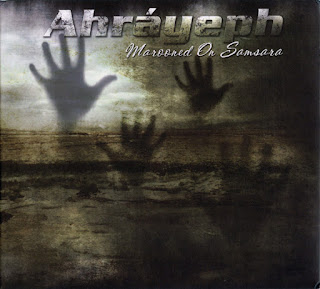
2008: it’s finally here: ‘Marooned on Samsara’, Ahráyeph’s debut. I’ve come to understand it was a difficult undertaking, because even though you had a band, you’ve recorded a lot of it by yourself. How happy were you with this album?

I was happy that the album was released and got the opportunity to do so via D-Monic. Contrary to what you often hear, I’ve never had any complaints about the label that released ‘Samsara’. They’ve always treated me fairly and stuck to the contract and the agreements we made. It’s just unfortunate they weren’t able to provide tour support because they weren’t big enough to do that. I’m sure they would have if they could have. That could’ve made a difference.


2008: I’ve only seen you live once, at a gig promoted by Bunkerleute at the Lido (Leuven, BE). You still had a band back then, now you’re doing everything on your own. Is there still a chance you’ll be playing live again with Ahráyeph?

That chance is definitely still there, but unfortunately, with the times being the way they are, it’s not the right time to start organising that. I’d have to find new musicians to accompany me, organise rehearsals, find a booking agency… As long as the pandemic rolls on and the uncertain times for artists continue, I don’t think it’s the right time to put all of that in motion, even if the desire to play live definitely exists. I’ve not played live for much too long and it’s something I always loved. After my first European tour with Ancient Rites, I knew I was born to be on the road, as exhaustive as it can be. I came back from that tour completely drained, but after just one night’s sleep in my own bed, I was ready and willing to jump back on the tour bus and do another ten days straight. That says it all. I come alive when I’m onstage, even if I don’t talk much or at all between songs. That’s not arrogance: my songs are my way of communicating with the audience, what more do you need to add to that? But I’d really love to do that again. If there are any interested musicians out there: you can always contact me through the band’s official Facebook page.
2013: You get the diagnosis of having Autism Spectrum Disorder. On the one hand, you’re extremely intelligent, on the other you have issues with things that are mere afterthoughts to the average person. Do you think this disorder had an impact on your work with Ahráyeph?

Without a shadow of a doubt. Everything I do, right or wrong, is being determined by my disorder. It’s only when I got that diagnosis, that I started to realise how deep the impact of it has been on everything I’m doing and everything I’ve experienced.

Allow me to say that I think it important to be open about my A.S.D. Some people, even fellow musicians, have tried to pressure me and told me I shouldn’t, but especially in times like these and after everything I’ve been through, it’s important to me to be able to be who I am. And I’ve also always supported other people in their quest to be who they are. I was bullied in high school, my family looked down on me… I ended up with bouts of prolonged severe depression and an extremely negative self-image because of that; I constantly hit the walls of my own boundaries, I was (and still am) considered a weirdo because I react in a raw and unfiltered way to everything, something I still often do because unfortunately, it’s beyond my control. I’ve been hurt, but I also have hurt, sometimes without realising just how much. There are certain relationships where, in hindsight, I have to admit I can’t hold it against those women that they ended them, because due to the combination of my autistic nature with those depressions and their ensuing self-esteem issues, I treated them less than they were worth. At the same time, I’ve also been easy prey for women who didn’t have my best interests at heart, due to my A.S.D. That’s how a song like, say, ‘Lilith’ came into being. Since my diagnosis and the therapy going along with it, I’ve become (more) aware of my own shortcomings, but just as well of my own boundaries, and that helps. Ahráyeph, in that sense, has always been an outlet for all these autistic experiences and observations. Ahráyeph is my self therapy. I certainly am not the only one in the music scene in that respect. And speaking of that self-esteem : it’s a lot better now. I don’t hate myself anymore, but the emotional damage I’ve accumulated over four decades has left an indelible imprint on me. It can’t be helped, but fortunately, I have Ahráyeph to help me deal with that.

Practically speaking, my A.S.D. has also interfered with Ahráyeph and cost me many an opportunity, because I am, after all, who I am and the disorder is an integral part of my personality, even if I am, obviously, more than just my disorder. I am simply unable to turn it off. It’s always there and that’s often tiring, even for me. And when it comes to interpersonal dynamics, it’s never easy to deal with other people. I’m extremely detailed and hence very verbose (for example: it’s not easy for me to keep my answers to your questions concise, because I want to paint as detailed a picture as possible, which is, of course, impossible), am always striving for perfection and hence am not making it easy on myself as well as others. And at the same time, I have zero tolerance for laziness, manipulative behaviour, and selfishness. When it comes to band dynamics, those were too often the causes for rifts, not just in Ahráyeph, for that matter.


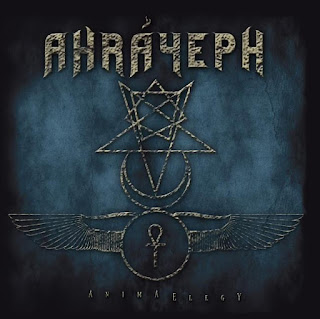
2015: It takes seven years before there’s a follow up to ‘Marooned on Samsara’, a delay caused in part by a serious burn out. Nevertheless, ‘AnimAElegy’ is a real gem. This time you record everything yourself, except for guest musicians on drums and keyboards. Are you still proud of this album?

Definitely. I have to correct you, though: Ness was not a guest musician, but a band member in Ahráyeph’s last live line up. It’s too bad she, too, had to give priority to her job, because she was without a doubt the Ahráyeph band member who meant the most to me, both on a personal and a musical level. I still miss working with her.

Getting back to ‘AnimAElegy’ then, I feel that it’s a step up from ‘Samsara’, even if my observation is that the debut struck a chord with a few people, more than this album or the releases that followed. Even so, when it comes to song writing, production and also lyric writing, I’m more than happy with ‘AnimAElegy’. Aside of ‘Desert Songs’ - which apparently is too long - all of my albums, E.P.s and songs are now on all streaming services, which makes me hope ‘AnimAElegy’ can burrow its way into the dark hearts of listeners a bit more that way, because I really think it deserves it.


2016: You release the 'Desert Songs'-E.P., building on the work of Robin Proper-Sheppard - a man who you happen to know personally - and his band The God Machine. Can you elaborate on the inspiration behind the ep?
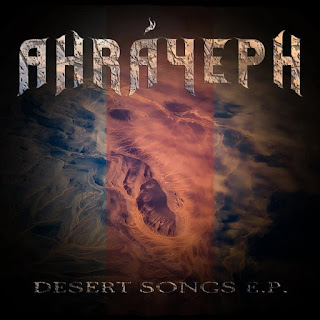
 I wouldn’t say I was building on Robin and his previous band’s work necessarily with this E.P. The God Machine are, as you know, a big influence of mine, but I’ve only borrowed that title, because when I was writing the songs, they evoked a desert like atmosphere in me. My mother, who is by no means a fan, observed a couple of times that I ‘write cinematic music’ and when it comes to ‘Desert Songs’ in particular, I do agree with that assessment. While I was composing, I kept envisioning scenes of big sand dunes, red evening skies with a sun setting on a horizon trembling from the heat, caravans ploughing through the sands, trying to reach an oasis and nightly desert skies lit up by stars and planets.

On the other hand, I was living through that burn out you just mentioned at the time. How I felt back then was described perfectly in the title track of prog metal band Queensrÿche’s fifth album, ‘Promised Land’: ‘Life’s been like dragging feet through sand and never finding a Promised Land’. Queensrÿche may at first glance not be a band you’d listen to as a goth (even if ‘The Mission’ and ‘Suite Sister Mary’ on ‘Operation:Mindcrime’ are early examples of what later would become ‘gothic metal’), but this album has a very dark and sullen vibe. It’s more Pink Floyd than heavy metal, but that makes the album all the better to me, and the title track is really very dark and depressing. Everything being described in it could have come from my own life back then, so that came to mind when I was working on ‘Desert Songs’. Thanks to the image of someone ploughing through sand and not getting anywhere, I got the idea to use that title and write lyrics in the same vein, which was surprisingly easy. I feel they are among my best lyrics, if not my best. The book ‘What Dreams May Come’ was also a source of inspiration. I remain convinced it also was the main inspiration behind Carl McCoy’s lyrics on the Fields of the Nephilim album ‘Elizium’. I had just reread the book and was riffing on the concept of the ‘Summerland’, the dimension in between death and the next reincarnation, so that’s part of it as well.


2016: With ‘Desert Songs’ you also announce a temporary hiatus to Ahráyeph. You want to concentrate on your metal project, Trans World Tribe, with singer Staci Heaton. The band releases an E.P. and a single in 2016, but fades into obscurity thereafter. What happened?

In short: just like Ness, Staci decided to give priority to her career. She works for the Californian government, where she is part of the environmental and agrarian department. She’s also married (her husband Brian recently co-authored the very first biography on the aforementioned Queensrÿche) and is raising a daughter. That all these things take precedence over a music project is something I completely understand. On the other hand, she’s a very talented singer and it’s a pity I can also no longer work with her. But Trans World Tribe isn’t dead, just hibernating. I don’t yet know when or how, but there will be a follow up. I still have plenty of demos and song ideas lying around to work with, so there’s no shortage of material for the future.


2018: You release the ‘Heavy like the ancient sun’ album, an homage to your deceased friend James Blaast!™. What was your motivation behind that?

James was, without exaggeration, my best friend. Our friendship was completely mutual, something I can’t say of many other people. It’s hard to explain why our friendship was so special… It just clicked from the first moment we met. It was as if we’d known each other our entire lives. That in itself wasn’t obvious, because as everyone who knew him can attest to, James wasn’t always the easiest person to get along with. He was very outspoken and didn’t mince words to the point where if his words had actually been meat, he could provide the whole of Scotland with prime, unminced beef for years. He also had no issues writing off people when he was done with them for whichever reason. Even I butted heads with him a few times because he crossed the line. But contrary to where he’d stick to his guns with other people, he’d always make the effort to make amends and respect my boundaries. He even told me so in no uncertain terms the last time this happened, and he kept that promise until the day he died. That’s the way he was. On the other hand, James was the most loyal friend a person could’ve had. He never thought twice about giving me a Facetime call and if I took too long to do so myself, I’d get a good natured ‘ERSE!’ in my mailbox, signalling it was high time for me to return the favour. Those calls turned into one- or two-hour conversations, sometimes twice that.

He also was very patient with me. If, for example, I had a bad day and kept that from him, he wouldn’t say anything about it, but, almost always successfully, tried to make me laugh, after which he subtly - yes, he could be subtle - let me know he knew something was wrong with me. The man knew how to handle raising my spirits without being intrusive. That’s real friendship. I thought I knew a lot when it came to music, but James, generous as he was in sharing his musical knowledge, taught me a lot more still. His knowledge of music was vast and his love for music even greater. It was all encompassing, especially where it concerned prog rock, goth and metal. The fact that I know Chameleons’ ‘Script Of The Bridge’ is entirely his merit, because this band wasn’t on my radar back in the 80’s.

He also was a graphic designer, something I later became too, in part due to the things I learned from him. I owe my diploma in part to him. He also managed to pass on his love for his hometown, Glasgow, to me. I love that city; I love its mentality and the people who live there and its good and bad aspects. James and I always addressed each other in ‘Weegie’, the Glaswegian accent, which I’ve since made my own, even if my command of it may have waned since I’m unable to talk to James anymore, like we did up until two days before he died. James was my brother from another mother and he and his mum Molly, who died about eighteen months after him, were fantastic people to have known. James also was Ahráyeph’s No.1 fan. It was he who bestowed the ‘prog goth’ label on Ahráyeph. He even came to Belgium to attend Ahráyeph’s very first live gig. His support was unconditional, even if he could be critical when he felt it was needed, which was also something I always appreciated. So why would I not honour his memory in a way he would have found fitting, with music?


2018: You release a reworked version of ‘Marooned on Samsara’ digitally. All songs were re-recorded. Were you that dissatisfied with the original recordings?

I was, actually. In the interim, my knowledge of music production had improved exponentially, and I also had better tools to implement them. I’m speaking in particular of the speakers I was using, the right studio speakers, which are different from hi fi speakers, make a huge difference. It’s something I learned empirically. All of a sudden, I didn’t have to work as hard to get a good mix, because I had a clearer sonic picture to work from. Additionally, the CD version of the album was sold out and no longer available. This made me feel it was the right time to re-record it and right a few wrongs. On top of that, I had a run in on Youtube with an American publishing company who, as part of my deal with D-Monic, had gotten their hands on the rights to my songs for the duration of the contract. I was warned I had no right to publish my own songs on the platform. Even though the rights reverted back to me after three years and I once again retained full ownership to the songs, I felt it prudent to re-record the album and re-register the songs, so I would keep the author- and publishing rights, so things like that would never happen to me again. People seldom realise it, but there’s a lot of administration involved when it comes to making music professionally, and if you’re not careful, there can be big consequences.


2020: You announce the ‘Heaven No. 7’-E.P. as an inbetween release to make up for the long wait for the next album. I do like it, and was especially impressed by the profound lyrics. Can you tell me how you handle writing lyrics for Ahráyeph?

Ooff, that’s a question that often gets asked, just like ‘how do you write your songs?’, and for which there is no simple answer, really. As I’ve already mentioned, my lyrics deal with my own experiences and observations. I would, however, like to write something from a different perspective down the line, even something fictional and I already have come up with a few ideas, which may even be used for Trans World Tribe, but in Ahráyeph, I mainly am addressing my own life and emotions, not least because, as I mentioned before, Ahráyeph is my outlet and therapy.

Something I do try to avoid, is to become political in my songs. I did make an exception to that rule during the repulsive Trump era and the events of January 6th. That’s how the song ‘Superspreaders’ ended up on ‘Heaven No.7’. The man is Roman emperor Nero incarnate and you can take that literally. Anyone going through the effort of checking out the Wikipedia page on that emperor can’t get around the often shocking similarities. Only, Nero didn’t have social media to spout his poison. But other than that, you shouldn’t expect any politically inspired songs from me, except if there would be a neo nazi and fascist takeover in this country and in Europe. That must be resisted by any means, even musical ones.

What’s always been really important to me where Ahráyeph’s lyrics are concerned, is that they work. I have a very allegorical and metaphorical style of writing, often laced with references to other songs, authors and metaphysics. That’s not just due to my literary and musical influences, but also to me not being good at writing ‘direct’ lyrics, in which I express myself in a more explicit manner, like, for instance, Robin Proper-Sheppard. If I write like that, it ends up in clichés and schmaltz and it ends up sounding fake. Whereas when he does it, I instantly believe what he’s singing. I once told him I consider him an impressionistic writer, both in the God Machine and in Sophia. It’s a craft and he possesses that craft, I don’t. Furthermore, I just don’t want to be a copy of anyone else. I’ve searched long and hard to find my own literary ‘voice’, another reason why that Crucifire demo makes me break out in hives of shame, because those lyrics were, for the most part, really bad, with a few nuggets here and there. The irony of it all is that, right after I finished that demo, I did start finding that unique literary voice to express myself through. It still wasn’t easy, but at least I found the right angle to express myself in my very own way.


2021: The ‘XXV’-E.P. is supposed to celebrate 25 years of Ahráyeph. It contains three songs, a Depeche Mode cover among them. How important was it for you to celebrate this symbolic anniversary?

A little, haha. Twenty-five years is a milestone, and it doesn’t suck to emphasise that, does it? It doesn’t really feel like twenty-five years to me and to be honest, it’s not as if I’ve had it on my mind for this entire year. It’s just that by the end of last Summer, I looked back on my career and realised it’s been twenty-five years since Jo, Peter, David, Raf, Geert and I got together in that rehearsal shack to become a band and work on songs together. That made it easy for me to couple the release of the ‘XXV’ E.P. with it. Also gave me an easy title, haha.
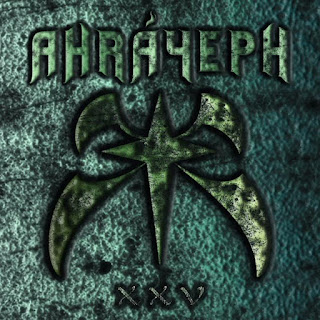

One constant, from the Crucifire demo to that E.P., is that I’ve always recorded cover songs. At that time, it was an English version of the song ‘Laatste Woorden’ (‘Last Words’) by Belgian band De Lama’s, retitled ‘The Hand That Feeds’, for which I wrote completely new lyrics and which I reworked as if it were a Type O Negative song, until now with Depeche Mode’s ‘Never Let Me Down Again’; because I always wanted to cover one of their songs (‘Stripped’ got discarded because I just couldn’t hear myself sing ‘Let me hear you make decisions without your television’ seriously). And since that song had a personal connotation for me, it was an obvious choice, even if I did manage to put in a few musical references to ‘Stripped’ en ‘Clean’ at the end. Funny thing : it was my cover of The Cure’s ‘A Forest’, conceived during the latter Crucifire days, which lay the foundation for what later became the ‘Ahrayeph sound’. The way I arranged it was kind of a light bulb moment which I would use to my advantage from then on, even if it has evolved over the years, because I don’t want to repeat myself.


2021: You release the single ‘Bloodletting’ with the promise to release a song from the next record each month. That didn’t prove feasible, but we’d love to hear about the new album you’ve been announcing for a while…

To be clear: those monthly releases were intended for the monthly ‘Bandcamp Friday’ initiative, which ran until May. But I did indeed struggle with the lyrics and was forced to postpone ‘XXV’s release, which turned out to be for the better in the long run.

As for the fourth album… It’s a bit of a tough one, because I wanted to approach it from a different angle than I usually do. I’ve got a certain concept in mind which I don’t want to disclose much about right now, but it requires me to write all of the lyrics before getting to the music. It’s not the way I work usually, even if there are plenty of Ahráyeph songs which had lyrics before I wrote the music. However, doing that for an entire album doesn’t seem to be all that straightforward, at least not to me. I’ve been struggling with it for a few years now and that’s also the reason why I’m releasing all those E.P.’s: if I’m sitting on songs that don’t fit the concept but are too good to save up for an album, I’d rather release them. Also, and I hate saying this because I love albums; but the album format is gradually losing its importance. Music these days is being - I’m this close to gagging - ‘consumed’ in a more fragmentary manner. Of course, true music lovers, who luckily still exist, will take exception to this statement because they don’t listen this way, but unfortunately, they’re the minority. That’s just the reality of it. I can’t release CD’s or vinyl albums for that minority because it would amount to a huge financial loss, not least due to the lamentable ‘renumeration’ streaming services ‘pay’ artists. It’s less than peanuts. Only Bandcamp, the platform I’m using to release my music, is treating artist fairly. Hence, it’s becomes important for artists to regularly release music and stay relevant and in the public eye, especially during a pandemic like this.

In the meantime, I’m continuing work on the album - I’m currently on hiatus due to my annual ‘hibernation period’ - but I can’t and won’t make any predictions about when it will be released at this moment. Just a few weeks ago, I think I’ve finally found the right way to open the story with and that’s been the thing I’ve been struggling with the most, because I already have several other parts written for other songs. But due to the nature of this concept, it’s essential that I start with Song One and finish with the last song, in order to keep things transparent and orderly for me. But it’s anything but simple, for me anyway, so I’d rather not say anything about it until it’s (nearly) done. But it will eventually be finished and released, that’s for certain, even if there will still be another E.P. coming soon.

Ahráyeph: bandcamp / facebook

The Dutch version of this interview first appeared on www.darkentries.be.

maandag 21 december 2015

Ahráyeph: I had known for a while that I was on the verge of burning out, but you always try to ignore it and keep going until it just stops one day.

With ‘AnimAElegy’ Ahráyeph delivered an excellent CD and perhaps thé Belgian gothic rock album. In the past there were often compared to The Fields of the Nephilim, but all the same elements of prog rock - Raf Ahráyeph likes to call it ‘prog goth’ - and black metal seep into the music. 'AnimAElegy' was a tough delivery, so we asked Raf for more explanation about this genesis.

Hello Raf. First and foremost, congratulations with your new album ‘AnimAElegy’. It's excellent. You've been working on it for a total of seven years, a biblical number. Are you satisfied with the result?

Hello Xavier. Thanks for the kind words. Yes, I'm definitely happy with the result. However, I have to put a nuance on those seven years : the songs were finished much earlier, but because there wasn't a recording budget available, and I didn't get offered a decent recording contract it has taken until now to release it. I've rejected three contracts because there were just pure extortion : in total, I would have had to pay up to three times more to have 'AnimAElegy' released on a label than I've invested on my own now, without even having one additional benefit.

We know you're very perfectionistic. Do you sometimes feel that your perfectionism slows down the creative process?

It certainly does. Perfectionism has its pros and cons. An advantage is that you'll work on something until the result is exactly what you have in mind and won't give up until that goal is achieved. One of the many disadvantages is that this way, you'll often burn yourself out and when you're working with others, you'll drive them into desperation. And when you lose yourself in all the possibilities that the writing and recording process offers, it strangely enough has a stifling effect because you don't know where to start first. It just short circuits my brain. Those are all factors I'm aware of by now, but channeling them into working more efficiently, is not something I've succeeded at yet. With others, I try to communicate as clear and as detailed as possible, but even that isn't always experienced as such, or even appreciated.

A lot of songs on ‘AnimAElegy’ have been out there for a few years. ‘Maiden By The Sea’ and ‘Resolve (A Dirge)’ were already released in 2009. Even of other songs - ‘Love / No Love’ - relatively older versions exist. Was it hard to marry songs together that were written over such a long time frame? How many songs on ‘AnimAElegy’ are really new?

Simply put : there are no really new songs on 'AnimAelegy', but that only applies to myself, because I've been living with these demos for so long before they were released on CD. A couple of songs didn't have lyrics yet, or different ones; others were only partially completed. That certainly applied to the extra songs, of which I felt they should be heard, even if they weren't part of the 'AnimAElegy' story. And since it has indeed been seven years since 'Marooned On Samsara', I felt it opportune to add those four: this way, you've got an entire listening session of one hour with the regular songs, and a nice EP added to the back of that. It was possible to put all of that on one disc, so why add a second one? That's just wasteful and bad for the environment.

You once said that the songs on ‘AnimAElegy’ are telling a story. Was this accomplished? And if it was, could we get the lowdown on the story behind 'AnimAElegy'? The album title - can we translate it as 'elegy of the psyche' - sounds rather intriguing.

For obvious reasons, I don't want to give away too much about the story being told in those first ten songs. It's up to the listeners to experience that for themselves. Let's just say that it is a reflection on a time in my life that wasn't exactly the most fun and of which the recovery process is still ongoing. A couple of years ago, the day after the Pukkelpop disaster, as it happened, I spoke with Sophia's Robin Proper-Sheppard, who has become a good acquaintance of mine. He had just released his last album 'There Are No Goodbyes' and told me that in spite of the praise he received from fans and press, he really didn't want to go so deep anymore as he did because, like 'AnimAElegy', the album refers to a dark time in his life and in spite of all the artistic accolades this honest musical retelling of so much pain being heaped upon you, you just don't want to suffer too much for your art's sake either. I could and can understand him all too well.

Let's go back to 2008's ‘Marooned on Samsara’ for a second. You were regarded as a Belgian Fields of the Nephilim back then. In what way do you feel ‘AnimAElegy’ differs from its predecessor?

It certainly is a more mature album; not just song wise, but also technologically. The album's production is better and this improves the songs' qualities as such as well. On the other hand, it's hard to quantify that. You do what you do and try to surpass yourself and when you think you've succeeded in doing that, you hope fans and press will pick up on it. I of course wanted to rid myself of that 'Belgian Fields of the Nephilim' tag. Yes, they were an influence; suggesting otherwise would be quite dumb. But I've never consciously imitated them and even if such a tag makes it easier for people to typify my music, it also creates unrealistic expectations. Carl McCoy, I am not; I don't write about Nephilim or Sumerian gods, and the magical and mythical allusions, if at all present, are being used in an allegorical and metaphorical manner. When writing these songs, I've cast all the 'Rules To Writing Gothic Rock Songs' aside for the most part and concentrated on what I wanted them to become. The story I wanted to tell was much more important than singing with a voice from the grave or adhering to the trad goth cliché sound which seems to work for other bands. That's not why I do this : Ahrayeph is my personal outlet, not a heap of genre clichés.

The release of ‘AnimAElegy’ was also slowed down by you having gone through a severe burn-out in the interim. How did this happen and how did you overcome that burn out?

One day, you wake up and find you are incapable of doing anything. And I mean nothing at all, not even communicating with others. You get out of bed to sit yourself down on the couch and stay there, completely burnt out, for the rest of the day until you can go to bed again. And so it goes, for years on end. I had known for a while that I was on the verge of burning out, but you always try to ignore it and keep going until, as I said, it just stops one day. Therapy has helped me to put myself in a better perspective, but the healing process isn't over yet. There are just too many issues that caused this burn out, and they all need to be put in their place and worked through before I can move on. But I've already been more active for a while now; I'm writing songs again - not for Ahrayeph, mind you, but for my metal project Trans World Tribe; I'm working as a vocal coach and I try to exercise regularly, because the cliché of a healthy mind in a healthy body isn't a cliché for nothing : it's true. But I still have ways to go.

You're still sitting on several songs you've never released. You once intended to release a cover album, you still have a lot of demos and you've admitted that only a few of the recorded songs were released on AnimAElegy... A few songs have been released via your Bandcamp page. What else are your plans with those songs?

I've recently decided to record and release two of those demos. They will also appear on the Bandcamp page between now and early next year. And that will be the last thing I'll do with Ahrayeph for a while. Concerning those covers : I've released a new, final version of my reworking of The Cure's 'A Forest'. It's not a remix; everything was re-recorded and got a new production. The rest of those covers are what they are and can also be found on Bandcamp. I have no intention of doing anything more with them. There's just one cover I'll be recording, which is, ironically, a Fields of the Nephilim song for a tribute album by the Finnish Gothic Rock Magazine. I'm not yet going to divulge which song I've chosen, but it won't be 'Blue Water', which we played at our first concert ever, and which was meant as a tip of the hat to Tony Pettitt, who headlined with NFD that night.

I understand that you've got a new metal project. Can you tell us more about it?

Trans World Tribe came to be through the mysterious ways of the Internet and social media. Through these channels I became friends with Brian and Staci Heaton, an American couple. Brian's a journalist and Staci works for the state of California. Hence, she has worked for Arnold Schwarzenegger when he was governor. But Staci also has a phenomenal voice. When I got out from under the worst of my burn out, I discovered that each time I picked up my guitar, metal riffs came pouring out. I still don't have to put in any concerted effort into doing that; they just flow out of me so spontaneously that I sometimes have too many ideas at once to record them all. And because it all came together so spontaneously and I didn't feel like singing or even playing everything myself, I initially asked Staci to sing. If I would be singing on those songs, it would again become too much of a genre cliché. Aside of Staci, other musicians will also take part in this project. Alex Martin, who also wrote a few drum parts for certain 'AnimAElegy' songs will be part of it, as well as several guitar and bass players. Staci's husband Brian would like to contribute some lyrics. But the core of Trans World Tribe is Staci and me. We already recorded a cover of Heart's song 'Alone', but it's not representative for the kind of metal I write, which is heavier, tighter and thrasier and contains more progressive elements. We only recorded that cover to see if we clicked. And we certainly do, because we tend to bring out new song ideas in each other constantly. We're currently writing demos, which we will record for a debut album sometime next year.

And what are Ahráyeph's future plans?

Nothing. I'm all 'goth'ed out' at the moment and am shelving Ahrayeph in favour of Trans World Tribe. I can't, at this time, say how long that will last. Perhaps I might start on new songs this time next year, maybe I'll never get around to it again, who's to say? I just can't say anything meaningful about that right now. I would have loved to promote 'AnimAElegy' live, but it's difficult to get the right personnel for that, or so I've experienced unfortunately. Maybe it'll happen eventually, but as long as it isn't, aside of those two finals songs and that Fields of the Nephilim cover, Ahrayeph will be on indefinite hiatus and my priority for at least the next two years will be Trans World Tribe.

Thank you for this interview!

You're welcome!

Interview: Xavier Kruth

Ahrayeph: website / facebook / bandcamp
 

Ahrayeph: AnimAElegy

Raf Ahrayeph is a perfectionist. Each detail has to be just right to him. And this in part explains why the wait for 2008's 'Marooned On Samsara' has been so long. It also explains - and this is the postive side - why this follow up - 'AnimAElegy'- is so good.
 
Important to know, is that Raf went through a severe crisis before 'AnimAElegy' could be made. The hardships in both the band and his personal life gave him a severe burn-out, which left him inactive for over a year. But aren't those often the circumstances in which the best records are conceived? How many great albums have been recorded by musicians who had to overcome massive problems?

Since 2001 - when he started the band - Raf Ahrayeph has had a lot of trouble to attract musicians. Perhaps this was in part due to his perfectionism, because it can't be easy having to work with someone who always strives for more and better. The consequence is that Raf recorded all instruments by himself, except for the drums and a few keyboard parts. He was able to realise his vision entirely, and this bears fruit.

Ahrayeph plays gothic rock, and is very good at it. The Belgian exponents of the genre can be counted on one hand (we automatically think of Star Industry, and also Erato, who also are exuding signs of life again after a few crisis laden years). After his debut, Ahrayeph was often compared with Fields of the Nephilim. We understand this comparison rather irks Raf, but it does remain a nice reference and one that applies to Ahrayeph, even if you can't accuse him of being a copy of the masters. Raf's voice, for example, differs significantly from Carl McCoy's voice from the grave.

It is mainly in the slow and atmospheric parts - 'Maiden By The Sea', 'Thread'... - that this comparison holds up. When things get a bit faster, the comparison quickly dissipates, like on the reasonably sharp 'Love/No Love' or the compelling 'White Square II' (which happens to be a reworking of an old Crucifire song, Crucifire being Ahrayeph's predecessor). Listening to the extended guitar solos of closing song 'Finale', one can't help but think of Pink Floyd, and on bonus songs like 'Pressure' and 'Awake' - the CD offers no less than four bonus tracks - we could even detect some black metal influences, especially in the drumming. This is no surprise, given that Raf originally hailed from the black metal scene (he used to be a guitar player in Ancient Rites). Overall, the guitars are very melodic and the synths add tension and atmosphere. A combination that works perfectly with Raf's hoarse and deep voice.

'AnimAElegy' is an extension to 'Marooned On Samsara', but is simply even better. Recorded better, more balanced, more detailed, more melodic... Fans should get this superlative to 'Marooned', and others - especially when being fan of gothic rock - absolutely should get to know this Belgian exponent of the genre.
Xavier Kruth
Ahráyeph: website / facebook / bandcamp