vrijdag 1 maart 2019

Laibach: In reality, nobody really wants to solve a Korean problem.


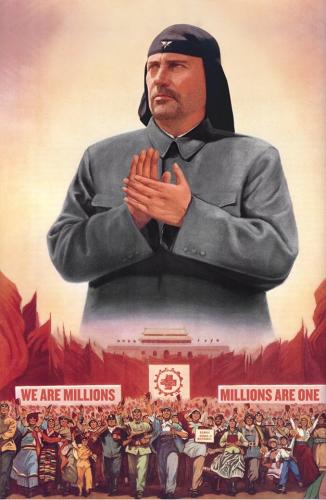
The big summit between Donald Trump and Kim Jong-un ended on a sizzler. We are not surprised at all, because a few days ago Laibach chief ideologist Ivan Novak told us that nobody really wanted to come to an agreement about North Korea. He knows, because in 2015 Laibach could perform with in the most isolated country in the world, a big stunt for the band that has devoted themselves for almost 40 years to the study of totalitarianism. In North Korea, Laibach played songs from 'The Sound Of Music', which they now release as a new CD.

‘The Sound Of Music’ is perhaps the most kitschy work you have ever done, with children choirs and sentimental keyboards, and of course the songs from a commercial musical from the sixties. Aren’t you afraid to lose the traditional industrial fans of Laibach?

No, not as long as they are true fans. True fans do not question, they follow. And regarding the industrial aspect - this album was created more ‘industrially’ than any other album that we did before. Total industrial process, pure industry! Anyhow - we don’t need anyone whom we cannot keep.

‘The Sound Of Music’ goes back to your concerts in North Korea, where you played in 2015. In ‘Liberation Day’ – the documentary about your trip to North Korea – I was surprised to hear you say that you wondered if we should take the dictatorship out of it’s isolation, since people appeared to be happy, compared to the rest of the world. Since when is Laibach concerned with the happiness of people?

Of course we are concerned about happiness; it is one of the most totalitarian concepts of the perfect, liberated world - on both sides of the hemisphere.  

The CD version of ‘The Sound Of Music’ also includes ‘Arirang’, a traditional Korean song that you performed in Pyongyang. There is no mention of the other two Korean songs that you adapted to Laibach ‘new originals’ and which you could not perform due to censorship: ‘Honorable Live And Death’ en ‘We'll Go To Mt. Paektu’. Why were they not included on the CD?

We couldn’t put everything on the album and didn’t find it necessary to include these two songs, as  ‘We'll Go To Mt. Paektu’ was already released digitally, and ‘Honourable Live And Death’ will be released separately in the near future, for another special occasion, related to our visit of North Korea.  

You dedicate ‘The Sound Of Music’ to the people of North Korea and Austria. The illustrations in the CD booklet indeed show mountains and landscapes that could belong in both countries. Are there more comparisons between both countries?

Yes, there are plenty of comparisons between both countries and The Sound of Music tells it all. 


Laibach is legendary for the role you played in ex-Yugoslavia, which was also a communist dictatorship. Of course a band like Laibach would not be possible in North Korea. What would you conclude when you compare communism in North Korea and communism in Yugoslavia?

Well, after all Laibach WAS possible in North Korea, otherwise we’d never performed there. But communism in Yugoslavia was quite different from the North Korean one, although Tito and Kim Ill Sung were good friends and visited each other in the sixties. Communism in Yugoslavia was destroyed because there was too much freedom around, with an overdose of black humour that finally killed it, as it was practiced and understood too literary.

Let’s go back to your former release: ‘Also sprach Zarathustra’. Laibach is a band that has based its work on the research of the link between ideology and art. I was surprised that you did not exploit the goldmine of controversial statements that this magnum opus by the German philosopher Nietzsche represents to a greater extend. Why was that?
But, we did it, and not only with ‘Also sprach Zarathustra’. You can find Nietzsche all over our work, although we are in principle not Nietzscheans, we consider ourselves Duchampians.

Let’s go even further back in time. Laibach has a tradition in apocalyptic predictions. On the fantastic ‘Spectre’ from 2014, we can hear: ‘Europe is falling apart!’ This innuendo very much seems to become reality. The United Kingdom is leaving the EU, while nationalist movements are on the rise in almost every other country. What do you think about these developments?

It looks like we will have to stop predicting things, because our predictions turn into reality very fast. Europe is in fact constantly falling apart but it seems that falling apart is Europe’s specific way of constituting itself. Every time it tries to re-establish itself, it fails better. But there probably is no other alternative for European countries anyway than a strong European Union.

What Europe needs most of all is a real revolution. The true utopia is that goals of social justice, financial stability and environmental sustainability can be achieved within the parameters of the global capitalist system. The real causes of the people’s misery, after all, are not caused by the corruption of a few hundred politicians or the greed of a few thousand bankers, but in the structural dynamics that enable and reward such behavior in the first place.

Today’s crisis cannot be solved by regulation — or ‘cosmetic surgery’ of any kind. It can only be solved by transformation into a different system altogether. A United Europe can be saved, not as the cold Europe of the Brussels political technocracy and banking sectors, operating according to the dictates of neoliberal dogma, but as a re-politicized Europe, founded on a shared emancipatory project.

The European Union must find the right balance between debate and consensus on an overall vision. That vision must permeate into all aspects of society. Without this vision Europe cannot progress. Diverse nationalist movements and the right wing expansion in the EU are on the rise exactly because of the lack of common social and political vision and because the prevalent political model in Europe is basically neoliberalism with a right wing management.

The majority of the nationalist politicians, who were elected in the EU parliament, are actually afraid to lose their well-paid jobs and positions, so their anti-European stances are most of the time merely a strategic pose for their frustrated national voters. Brexit is the extreme paradox of this situation. Of course Europe without Britain is not what it should and could be, but in a way Great Britain never really wanted to be a part of EU. Britain wanted Europe to be part of Great Britain, except on safe distance, as a tourist destination and a healthy market for British economical and cultural expansion.  


The international situation involving North Korea has changed very much since your shows there in 2015. It was then an international pariah due to tests with nuclear weapons and long-range missiles, but has now entered peace-talks with South Korea and the United States. This détente is fragile, of course, as love declaration still can change to brutal statements and warnings. What do you think? How do you solve a problem like Korea?

You don’t solve it, especially not with Trump. In reality, nobody really wants to solve a Korean problem. The current North Korean leader Kim Jong-un and the South Korean president Moon Jae-in are actually developing a very healthy process that is opening possibilities for reunification of both Koreas into one country. The basic problem is that Americans do not want to close their military bases in South Korea and this will be the biggest obstacle for the reunification.

Americans are not interested in North Korea. They are interested in China and they want to keep an eye over the East China Sea. They are surrounding China with something like 40 military bases and their base in South Korea is among the most important ones. The troublemaking North Korean regime is just a perfect excuse in the whole equation, but not the real target.

On the other hand China will not allow the reunification of Koreas for as long as US troupes will stay in South Korea. That is why North Korea as a country and its people are basically just a collateral damage of this power game between China and United States, and that is why White House does not want to sign a final peace treaty with North Korea already since 1953.  On top of that Japan is not very happy with the idea of united and economically strong Korea.

China is not very enthusiastic about it either, and the majority of South Korean politicians are opposing the re-unification because of the high costs that South Korea would have to pay into this project and on the other hand the military and political elite of North Korea also do not want to lose their privileged positions and even less their heads if such unification would really happen.  Therefore all the talks that are going on between North Koreans and Americans are merely just a spectacle, showing Trump’s good will and his ‘presidential wisdom’.  Unless Kim Jong-un and his sister are hiding another strong joker in their pockets, there is not much hope that something will really change for the North Korean people.  

zondag 24 februari 2019

Trouwfest #3: RIOTMILOO: We love you Europe!

The free annual Belgian festival Trouwfest offers at least one artist that will perform for the first time ever in Belgium in every edition. This year, this is the case (among others) for the French/Brittish act Riotmiloo, who released the great album La Pierre Soudée on Ant-Zen a few years ago.

It's a very strong album, not only musically, but also conceptually. Emilie is a lady who has a lot to say, something this interview also taught us!

DE: You released your album on Ant-Zen. Recently, Ant-Zen decided to stop releasing physical albums and to concentrate on the digital market. A sign of the times? As a music lover, for me it’s quite hard to pay for a digital album, because just like books, I like to have a copy in my hands. What’s your opinion on this, as a musician?

Emilie (E): When I found out, it really came as a blow. Music is extremely important to me. I listen to music on different formats (including digital) but I buy my most cherished music on physical releases. Ant-Zen fought long and hard. It brought quality in terms of musical choices and strong identity with Stefan Alt’s amazing designs. It went beyond music and design; it was pure Art. But times change and if cds don’t sell anymore, maybe it’s time to try something else? One may argue that vinyls and tapes seem to be trendy again. But how long will it last? I wish Ant-Zen the best for the future. I am forever grateful for everything they did for me.

I guess artists may have to diversify what they have on offer in the future. I started selling t-shirts last year (design by Stefan). People seemed interested by that new addition to the merch. However, I still don’t know how I would feel not to have physical objects to sell at gigs. I guess it is part of all the questions I have to reflect on when my next album is ready…

DE: You started your musical career in the riot grrrl’s punk scene. Can you tell us a bit more about that (which band, period, etc...)

E: I discovered riot grrrl’s music in the middle of the 90’s. Instantly, I identified strongly with that movement: the anger, the messages, the possibility of having little experience but still having a space for creativity and of course the DIY attitude. Kill Rock Stars was a fantastic label. My old time favourites are still Bikini Kill, the Japanese Emily’s Sassy Lime and their album “Desperate, scared but Social.” I still have a lot of affection for Babes in Toyland, Seven Year Bitch and of course L7. I saw Babes in Toyland when they reformed, singing all their songs from the top of my lungs (because I have all of their discography).

When I was still living in France, in the late 90’s, I was invited to perform as a guest vocalist for a friend’s band. It was meant to be a one off. But when I set my foot on the stage, I transformed into Riotmiloo for the first time. I started shyly with my hands in my pockets and ended up confronting the crowd and rolling on the floor. Many people in the audience saw something in me that they liked and encouraged me to carry on.

In 2003, my friend Slideling and I decided to create a female garage punk band in the spirit of Red Aunts and early Yeah Yeah Yeahs. We enrolled the best drummer in town and Venom Seeds was born. Originally, we wanted a female drummer but when Sam auditioned, he blew us away. We got signed and released a beautiful and limited edition 7” in black, red and white on a grunge label in Seattle. Even before, when we self released our DIY interactive demo with wicked stencil artwork, it was well received in England and abroad. This project went far beyond what I was expecting. Sadly the band split up in 2008. If you want to dig more into that bit of my past, here is where to find the info: http://www.venomseeds.co.uk/


DE: What did you decide to change from guitars to electronic music?

E: My love for music is vast. Besides Riot Grrrls, I also like punk hardcore especially bands like Minor Threat and pioneers like Blag Flag and Bad Brains. Simultaneously, I happen to also like trip hop and electronic music. In the early 2000’s, I discovered Atari Teenage Riot and D-Trash records. There was Nic Endo’s sonic assault and Hanin Elias’ amazing live performances. Once again I identified to that sort of music. I thought to myself: should I experiment with this? It was pushing the violence and anger a little bit further.

Shortly after moving to London in 2002, prior to Venom Seeds, I was part of a DIY electronic project called “3 Ant Riot.” We had a tweaked bass, samples, drums and me on vocals. This project enabled me to experiment more vocally with electronic music. In the end, things didn’t work out because some band members wanted more melodies and I wanted more mayhem. ;)

I started getting deeper into electronics when working with the artist and producer Eva|3. At the beginning, we were meant to collaborate only for one track. Then we performed together for a one off gig at Slimelight in 2005 in London to support Pneumatic Detach.

It went so well that he asked me to join him for more gigs and two years we unexpectedly landed at the legendary Maschinenfest to promote Eva|3’s album on Fich-art! (Asche’s label)

DE: You can hear the influence of your riot grrrl period in your current music. Speaking of electronic music: what are the musical influences on Riotmiloo?

E: If we talk solely about electronic music, I am influenced by Haus Arafna and their side project November Növelet. I do like the integration of both harshness and melody. I love Deutsch Nepal too. He excels at converting emotions into music. Test Department, Coil and Throbbing Gristle inspire me a lot too. I am a huge fan of Beta Evers whose cold vocals and music give me goose bumps.

At the minute, I am really into Michael Idehall, Hide and Gazelle Twin. And I have a recently discovered soft spot for Lingua Ignota. I am going to share a stage with her on the 9th of April in London. I can’t wait! https://www.facebook.com/events/1964796276952596/

DE: Your gig at Trouwfest will be the first one in Belgium. La Pierre Soudée showed us Dirk Ivens is one your friends, are there any other Belgian musicians/bands you really like?


E: Yes, it will be my first time ever in Belgium. Thanks a lot for the invite. I am really looking forward to it. Belgium is lucky to have so many great electronic artists. Dirk Ivens is definitely a legend and a very kind person. He is very funny too. The other names that spring to my mind straight away are Imminent, Ah Cama-Sotz, Monolith and Solar Skeletons. There is also Empusae. His album, “Lueur”, really spoke to me to the point where it gave me goose bumps. I highly recommend it. Nicolas has a gentle soul and is a talented musician. I also admire C-drík’s musical knowledge and efforts to promote electronic music from all around the world. He is a good laugh too.

DE: La Pierre Soudée sounds very intense, I can imagine live it even goes deeper. How would you describe a Riotmiloo concert, what can we expect at Trouwfest?


E: It took us six years to make “La Pierre Soudée”. Each track is inspired by a real life story, documenting women’s suffering in the world. Each song was composed with a different artist. You can enjoy listening to the songs or if you choose to dig a little bit deeper, get to know each story, find out about the horrors inflicted by wars, by lack of compassion, by political and social harsh contexts. And then you can decide for yourself. Beyond music and words, where do you stand in our society?

My performances have often been described as intense, powerful, energetic and moving. The music creates an emotional journey ranging from dark ambient soundscapes to powerful rhythm and noise, supporting my vocal delivery that is in turn melancholic or intense. Visuals add another layer to reinforce my message courtesy of the brilliant haunting double exposure photographic work of Jessica Hosman. Expect a cathartic and hypnotic experience!


DE: Power electronics and noise in general are mostly a male-dominated genre. But nowadays there’s a fresh feminine air with acts like you, but also Pharmakon, Puce Mary, Sewer Goddess, She Spreads Sorrow... As a woman, do you think the audience/press treats you different and in which way?

E: I think Arts and Music in general are male-dominated (and not just in the making of it). Statistically, the audience is more male than female too. Is it because of bad experiences for women at gigs? Is it because the music is too harsh? On the other hand, many people, from promoters to the audience, seem to be open to something else. I have always been lucky in the sense that what I want to express and say resonates with others. Am I just lucky? Maybe, maybe not, who knows? I have the strong belief that there is space for women in the Arts. I welcome female and trans artists. In my humble opinion, diversity is somehow more interesting.

To be honest, I don’t feel the press has treated me any differently. Photographers are respectful too. People are in general very supportive. The worst that happened to me was being touched inappropriately during a performance in Paris and I lashed out at who I thought was the culprit. It turned out it was a gay friend of mine who confessed many years later. But I have female friends who have completely different experiences…

DE: La Pierre Soudée refers to Masculine Domination by French sociologist Pierre Bourdieu. In this work he describes how language symbolically defines and perpetuate violence against women. In lots of countries, women are still oppressed by men, often by giving it a religious twist. It’s quite a challenge to stop this madness. Do you think this will ever change?

E: First of all, I’d like to widen the debate. Violence happens everywhere. I wouldn’t want to confine it to far away countries. You have open direct violence, which is spoken about a lot in the media, and you have slow, pernicious and hidden day to day violence. Female Genital Mutilation happens in Europe, in the UK, it is not just confined to Africa. I read yesterday about breast ironing supposedly in place to help prevent sexual harassment and rape. What kind of shit is that? The best prevention is to teach about consent!

What pisses me off is that governments, people in charge of writing laws, are mostly white wealthy men who will decide women’s’ rights. Let’s take for instance the topic of abortion. It is still illegal in Northern Ireland. And people in power like Trump make me feel like we are going backwards to darker times when people accept the very idea that it can be ok to “grab them by the pussy…”

And then there is hidden day-to-day violence like when a woman is shut down, interrupted more than men or even totally ignored. And have you heard about “the mental load”? To summarize, it is when one expects their partner to ask for help to do things, viewing this person as the manager of their household chores. Here is an interesting article if you want to find out more about “the mental load”: https://www.theguardian.com/world/2017/may/26/gender-wars-household-chores-comic

I believe change is possible but we have to implement it ourselves at our own level. And I am grateful that many people agree with me.

DE: On a scale of 1 to 10, how much would you describe yourself as a feminist, and what does this term mean to you, because for some people it has a negative undertone?

E: My definition of feminism is equality and same treatment for everyone. Who can be against that? Following this definition, everyone can be a feminist. It isn’t hard. I would give myself 10/10 of course. And if you take into account non-binary people, this means that they should also be treated with respect. The TERF movement (Trans Exclusionary Rad Feminism) is against that very idea and deserves not to be associated with what I call feminism. Their message is full of hate and discrimination. Mine isn’t.

DE: As I told you before, your work reminds me of the great Meira Asher. Have you already contacted her?

E: Meira Asher is very talented indeed. I know about her work but do not know her personally. I love it when music and song writing incorporate poetry as well as a message. When words and music complement each other to highlight social and political topics, then it takes Art to another level…

DE: Alongside your musical performance, both electronics as vocals, another eye catcher are your quite controversial lyrics. Another thing you have in common with Meira Asher, with subjects such as child marriages, war, landmines, AIDS,... Do you already have stories in mind to tell on a future album, and are you working on it?

E: I spend a lot of time reading articles and taking notes. The theme of “La Pierre Soudée” was abuse of women through story telling. I am currently working on another album. “Blackout” is more a study on mental illness and how it translates into feelings. I want to strip it out of all romanticism and explore a raw territory. Once again, I had to collate information from real life stories, watch documentaries, absorb various experiences and states of mind to be able to translate it into words and music. This time, it is just Eva|3 and me (and synths and patches.) I have recently uploaded a new track called “Folie à deux” which illustrates a story of shared madness where a couple tortured and murdered their nanny. She was "starved, tortured and broken until she could no longer fight. They took away her dignity and finally her life." May her gentle soul rest in peace. Here is the link if you want to listen to it: http://www.riotmiloo.co.uk/media.html

DE: As a French woman living in England, how do you feel about Brexit?

E: Well, I am a product of Europe. I was born in France and I decided to live in London. And I play gigs all over Europe. Until now, it was easy and convenient.

Most people in London are against Brexit. I love London because it has a great mix of different people and we all learn from each other. Even our mayor Sadiq Khan trolled Brexit with an ode to Europe using fireworks display for New Year’s eve. That was so brilliant!

More personally, I feel Brexit is a con; it is a broken plaster failing to contain the pus in England. Who in their right mind would think it is a good idea to go solo in the big wide world?

I blame politicians for this mess. They haven’t lifted people out of poverty. They actually created more of it. Our previous prime minister, David Cameron, used the referendum for his own political gain. Then he lost and resigned, passing on the hot potato to somebody else.

Our current prime minister is doing the same. Theresa May is using Brexit to sell her anti immigration and rotten ideas. She is anti immigration and anti poor.

I think many people were tricked into voting for it. But Brexit is not going to benefit them. In my opinion, there will be more and more suffering and more stories like in the movie “We are all Daniel Blake” by Ken Loach after Brexit.

By contrast, wealthy people will be fine. They have connections and ways to buy passports. Some of the richest businessmen are already leaving England and relocating somewhere where there is less tax, often in Europe.

I feel artists will suffer too. Who will want to come to the UK if they don’t feel welcome? I won’t blame it if people stick their fingers at England. I kind of sadly expect it. It will become harder for British artists who are already struggling to cover expenses to play abroad.

But rightly so, a good friend of mine told me that politicians never really help artists anyways. So I guess it will be up to us to unite and find ways to make it work. We love you Europe! ;)

DE: Last but not least, this burning question: why do you want a fly as a pet?

E: I found those words grabbing. So when they popped into my head, I decided to make something with them. The life story behind the song "A Fly as a Pet" actually comes from a book called “The good women of China.” It talks about a girl being abused and breaking her own bones to end up in a hospital and escape her life as well as her oppressor. There, she experiences the soft feeling of the wings of a fly on her skin for the first time. She decides to adopt it as her pet. In the end, she becomes really ill, crushes the fly by accident and mad with herself, spreads the dead fly on her wound and dies from sepsis. It is a tragic story really… 


foto's 1 & 3: Sev Denis, foto's 2, 4 & 5: Stefan Alt

Riotmiloo

La Pierre Soudée op Bandcamp

Trouwfest #3

dinsdag 12 februari 2019

Hackedepicciotto: Anything that sounds unusual attracts me immediately


When the first names for the Black Easter festival were announced, we couldn't resist a jump for joy. We tipped Hackedepicciotto because, in our humble opinion, it was the right act for this festival. Luckily BodyBeats shared this opinion. Not only did the couple Alexander Hacke and Danielle De Picciotto released the very strong album Menetekel, both of them gathered a lot of musical experience through the years and thus were the ideal candidates for an interview.

DE: When our readers see the name of Alexander Hacke, most of them will automatically link it to Einstürzende Neubauten. Danielle, you’re know as one of the founders of the legendary Love Parade and was involved with Gudrun Guts Ocean Club, Space Cowboys, Die Haut and many other projects. Hackedepicciotto is a recent project, although you already made music together before. Is Hackedepicciotto a new start of something?

Danielle: hackedepicciotto is part of an ongoing work process Alexander and I have been immersed in since 2001.We have done very many different collaborations together over the years: interdisciplinary projects, theater plays, film music etc.. hackedepicciotto became our band name when we felt we had found the sound that fitted perfectly to both of our characters.

 Alexander: Hackedepicciotto is the accumulation of our combined efforts in equal parts. Like the name suggest it is more of an symbiosis than a collective. We’re not a band with replaceable members, we’re one entity.

DE: You’re married in 2006, and the cliché wants us to keep work and private life apart. How do you manage as a couple to work together, does it bring some extra tensions, or is it just easier to work with someone that’s so close?

Danielle: We are working together not because we are a couple but because we complement each other perfectly in our tastes and talents. The fact that we are a couple is beautiful but even if we were not a couple I would love working with Alexander because he always comes up with something I would not and vice versa.

Alexander: We know and trust each other more and better than anybody else. At the same time we are very different from each other and may approach issues from opposite angles. That can cause friction, but in the end we are always better off that way and see it as an advantage to have a variety of ideas to draw from.

DE: Since 2010 you live as nomads all across the world, constantly touring. A very intense lifestyle which made you both decide to stop smoking, drinking, becoming vegan and start with meditation and yoga. Has this current lifestyle made you more conscious of life than before?

Alexander: Of course! And I don’t think that we would be able to survive tis kind of life any other way. It is also quite rewarding to escape that cycle of punishment and reward, of work - excess - hangover - work and so on, which particularly many artists are prone to

Danielle: This experiment changed my life completely. It has changed my perspective on art, health, spirituality and society. It feels as if I have been put into a fast forward motion of personal development in which I am learning things at double speed which I would have otherwise spent my whole life discovering.  The first and very important aspect was getting rid of everything superfluous in my life. That in itself was a life changing catharsis. 

DE: Which brings us to ‘Nosce Te Ipsum’: did you met yourself on your trips?

Danielle: Most spiritual leaders or philosophers say that understanding yourself is the first step towards enlightment. It is also the most difficult. I would say I am starting to understand myself a little better but still have a long way to go.

Alexander: “Know Thyself” is the essential hermetic motto and a valid goal to aim for. “Be Thyself” and “Love Thyself” are the next steps. Necessarily in this order, because you can not be or love anyone you do not know.

DE: The first Love Parade was in 1989, initialy to celebrate the birthday of DJ Motte. Danielle, you were one of the co-founders of this event that became the biggest dance event of the world. How long did you do this, and how do you remember these days?

Danielle: Motte and I initiated the Love Parade because we felt that music can cross all borders and wanted to make a statement of peace and joy. The fact that it became so big was a confirmation that many people all over the world feel the same way. Another wonderful fact about this collaboration was that we made it happen with very little money. We had a lot of enthusiasm and the Parade became a symbol of the fact that everything is possible and miracles can happen. I was part of the Love Parade until we had 1.5 million participants. After that I decided that I am an artist and not an event manager and went back to doing music and art. The times in the late eighties and early nineties were magical because it was the beginning of a new era. Everything was new and exciting, the world seemed to opening up to something positive and Berlin was a playground of creativity. I am very happy to have been able to experience these years in Berlin because it gave me an incredible foundation of fun and know-how.

DE: I remember in the 90’s, it was absolutely not done when you were listening to what they called “alternative music” to listen to dance. Nowadays (fortunately) the musical landscape changed completely. It’s easier to get access to music, and back in the days everything was more divided into different parts. Berlin was always a very important city for music, was there a comparable reaction?

Danielle: Crossover has always been really important to me. My first band “Space Cowboys” was a cross-over hip hop/rock band and I was their singer whilst working in techno clubs such as the Tresor, so I never felt imprisoned in a specific genre. Berlin has always been a city that has broken down barriers. Being a interdisciplinary artist and working in different medias was already popular there in the eighties. That is why I moved to Berlin from NYC. I do not think there was a city comparable back then.

DE: Alexander, we can hear you throat-singing. My wife is a huge fan of Mongolian and Tuvan acts like Huun Huur Tu, Yat-Kha and AltaiKai. Where did your fascination come from, and was it hard to learn it?

Alexander: My musical tastes have always been very eclectic, so I am certainly aware of Tuvan throat singing. I started practicing it as a kid though, totally unrelated to music, by trying to talk like a robot to amuse my mates in elementary school. Much later I got introduced to recordings of Inuit people from Northern Canada and I realized that they apply the same technique and I started to explore how far I could take it myself, without a teacher or direct musical reference. I am still working on the overtones...

DE: Talking about the throat-singing technique: have you ever heard of the Russian monks of Phurpa? They practice upside-down and drink black tea with chili peppers and cream for their vocal chords. Do you have a special method to train your voice?

Alexander: No, I don’t know them, but will investigate. I also like some “pain" with my food though, which allegedly helps and to be a non-smoker can’t be bad either.

DE: You both also use a lot of less common instruments like the hurdy gurdy, autoharp and the Turkish kemençhe. Is this also due to your travels that those instruments had their influence on you?

Danielle: I have always loved odd sounds. In a way my music can be considered sound art more than anything else because I am always looking for a specific tonality. That is also how I chose my instruments. Anything that sounds unusual attracts me immediately and that is how I discovered my instruments.

DE: The result we hear on Menetekel is a very rich sound. Also quite unique, the only reference I could make in my review was Swans, with Jarboe. What’s the most original comparison you’ve already heard when people want to describe your music?

Danielle: I am not interested in comparisons.

Alexander: The most original, I suppose, was to be compared to “The Revolutionary Army of the Infant Jesus”, an obscure English neo-folk band.

DE: Alexander, I always was (and still am) a big fan of the Crossing The Bridge documentary you made with Fatih Akin, that deals with the vivid music scene in Istanbul. I was in Istanbul twice, and you succeeded in bringing the feeling I experienced when you dwell through this wonderful city. In the documentary you also played together with Turkish musicians. Do you still have contact with some of these artists?

Alexander: I’m still in touch with Murat Ertel of Baba Zula, in him I have found a kindred soul concerning our musical tastes and sense of humor.

DE: The artwork of Menetekel is based on the iconic painting of American Gothic. Was there a particular reason you’ve chosen that work?

Danielle: I was not thinking of that painting when I was doing the lithography. Originally I did not plan for it to be the record cover, I was just experimenting on this technique and as our nomadic journey is my main artistic theme momentarily I tried to convey what we feel like at the moment. When Alexander saw the first result he said: That is our record cover!

DE: Menetekel refers to the writings on the wall in the Bible, just like Jericho. Alexander sang in the past with Einstürzende Neubauten of ‘Der Schacht von Babel’. Why this fascination with the Old Testament? Is it just because of the beautiful stories, or does it have a deeper meaning?

Alexander: We study a variety of sacred texts. I consider music, all arts actually, but mostly music, to be a direct means to get in touch with the Devine and cherish and respect the craft for that quality. Creating vibrations like that is a matter of cause and effect, which should not be taken lightly. Music is spiritual by default and as a spiritual person I am interested in spiritual allegories.

Danielle: Interestingly our journey feels biblical in many ways, like a pilgrimage towards some kind of truth. This kind of search touches many basic human and social themes, which often are mentioned in spiritual books, one of them being the bible, so becoming immersed in these subjects has become part of our work. This obviously influences our music.

DE: Globetrotters as you are, you must get in touch with all kinds of habits and religions. Do you adopt things of those impressions in your daily life?

Alexander: Yes, we research, discuss, meditate and try to adapt what we learn in our work.
Danielle: Yes we have learned a lot from the different cultures and countries we have experienced on this journey and they influence our thoughts and development.

DE: We’re very delighted you are going to play the Black Easter Festival, what can we expect from your show?

Danielle & Alexander: We will be performing our current album Menetekel, songs from our last album Perseverantia and new songs that will  be released on our next album.

 Hackedepicciotto

Black Easter


donderdag 7 februari 2019

Monica Richards: I always felt out of step with the Modern world, ever since I was a child, I do even more so now.

Monica Richards is one of those names who doesn't need a further introduction. These year the goth icon will perform at the Black Easter festival in Antwerp, where she will play together with Anthony Jones. A great opportunity to talk with this multidimensional artist.

DE: You were booked for the Black Easter festival in 2016, but had to cancel due to health issues. I’m glad you’re better now, because it was quite serious Ward (organisation Black Easter) told me. Do you want to tell us about it, or rather not?

Monica: It’s thyroid, and unfortunately it’s a bit chronic. I was hit very hard in 2016, as it’s connected to my throat, and my voice was not in good form at all. I was facing surgery but the doctor decided to not to do that yet. At the same time, the band I was bringing were very relieved about the cancellation, we were due to arrive the very day the bombing happened at the airport.

DE: At this year’s Black Easter you will perform together with Anthony Jones, just like you did at the WGT last year. How did this collaboration came to life?

Monica: I have known Anthony for many years through the scene, and have admired him so much as an artist. His style and my own are similar in the World-music, electro-tribal One-Heart style. He got in touch with me about doing a live show two years ago at a time when I wasn’t really interested in performing. But Anthony had some wonderful ideas about putting some of my songs together for live performance as well as his own, so the idea took off from there.

DE: Together you both also released the EP SYZYGY. A term with various meanings but here refers to astronomy. A shared passion?

Monica: Anthony suggested this title and I looked into it. It is found in many sacred and philosophical texts. I went through some of my books and there it was. After I read from a few different sources, it seemed perfect.

DE: Are you also planning to record a full album with Anthony?

Monica: We are at work on it right now! We have a new song “Avalon” to come out end of this month (February).

DE: Also in 2017 there was a new album of goth supergroup The Eden House. Also in The Eden House is Evi Vine, who also plays at Black Easter. We wouldn’t be surprised if she also will share the stage with you for one of more song(s)?

Monica: I have not met Evi but really quickly, I think in Poland, 2010, when I jumped on stage for To Believe with the Eden House. I do hope to spend a bit of time with her in Belgium, and looking forward to her set, I think she’s brilliant! But we have not planned anything… Our time in the Eden House were different albums, so we have not shared the stage properly.

DE: Do you also have plans to record new work with Faith And The Muse. Because the last album’s already 10 years old, some people are wondering of FATM still exists?

Monica: No, that era has ended.

DE: Alongside your music, a few years ago you published a coloring book for adults, which was quite a hype. I know some people do coloring for some therapeutic reasons, was that also the reason why you’re interested in this kind of medium?

Monica: Cat Carnell from the brilliant classic 90’s Goth magazine, Carpe Noctem, (do you remember this mag)? She was publishing coloring books and asked if I would make one with her. My art style has always been with outlines very thick, so I thought it might be a nice challenge. It was actually very therapeutic to draw them, and then color them so that I could check the lines. It was a great project for that year.

DE: You’re a painter yourself, and a detail of one of your paintings is used for the poster of the festival. When I look at your paintings I see you often choose to paint with loud colours. My wife (who is a huge fan of you) also paints, and also uses this colors. In her paintings it is to make ‘dark’ themes more colourful. Is it also why you use these colors, or do you have another reason?

Monica: I am a giant fan of Art Nouveau, which can be very colorful. I have always loved working in color and patterns. Color can bring out a great deal of emotion. Black and white is wonderful, but add some color and BAM! you can change the whole feeling… Zeva seems to have a lovely style.

DE: You did not only publish the coloring books, but also wrote some actual books, like the graphic novel Anafae. Are you still writing, and if so, what are you working on?

Monica: I am writing all the time, mainly poetry. I have also many micro-stories. I have been working on a new classic work of music, so they are on the back burner. It’s very very hard in this new Modern online world to put out a book. Our attention spans have been severely damaged by social media and too much input. So I’m unsure when I will release new written work.

DE: Completely justified you’re called a goth icon. But, what does gothic really mean to you?

Monica: For me, a longing for a more classical time, a simpler beautiful time - but it is a reimagining of the past, not the reality of how hard it actually used to be. I always felt out of step with the Modern world, ever since I was a child, I do even more so now. So Goth and all of its classic splendor spoke to me, romantic, dark songs and clothing, depicting something dream-filled and deeper than life. 

DE: Gothic has become a ship with many flags, you have the old school gothic rock, deathrock and batcave who leans more to (post)punk. But you also have electronic music you only hear at goth clubs, a genre in which we find Anthony Jones. Dark folk, noise, industrial, minimal, medieval,... all completely different, but all present at big events like WGT. Are you a musical wolverene who swallows it all, or are there styles you completely don’t get into? Did you recently discovered some acts you really like?

Monica: Well, I came up in all of it while it was brand new, so it has all been alongside me on my path. You know my music was called “Doom and Gloom” before the term Goth came along! I think I am known for my diversity. With Faith and the Muse, we decided to do any and all types of music we wanted to, Medieval, Celtic, hard rock, death rock, Sea Shanty, even techno. I do what I like in my solo music, I’m more about the song than the style, if a song or lyrics move me, a melody or riff that’s really great. The highlight for WGT for me was seeing Warduna, just brilliant live. I’ve been listening to the band Clutch lately, great hard rock, good lyrics and musicianship - they are not in the ‘scene’ at all, but they’re really cool.

DE: One of my favorites of your solo work is the song ‘Like Animals’, especially because the lyrics are spot on. As I encourage a vegan lifestyle myself, I think it’s important people like you keep their audience aware of this subject. When it comes to animal rights, do you call yourself an activist?

Monica: Thank you! That song was actually originally in the 1960’s “Dr. Doolittle” which I adored as a child. For me, I do things in my own way, and I find people are more willing to look and listen. So I am not a hard-lined activist, but an InfraWarrior (warrior from within). I find it’s best to do your thing, and show why you do it, but don’t push anger and judgment upon others. We can look at the many new vegan products that are coming out, as well as their easy access in large grocery stores to show that Veganism is on the rise, be it for health or for animals, it is going in an upward direction globally, which is great.

DE: Hot topic today is global warming. You can be optimistic and say: better late than never but do we have a reason to be optimistic. Do you think our earth is doomed?

Monica: I think we can view it that way for humanity, especially while the insanity of religious dogma and the need for money and power prevail. This brand of philosophy is the definition of Disease. But there are thousands who are working hard on positive solutions, and we must look towards them, not only the negatives that are blasted at us all the time. We are dealing with rising weather events, which will change our ways of living more and more, and we are a very adaptable species at the core despite the insanity going on at the top. We have the ability to change our behaviors. I have a website about my work in Permaculture: infrawarrior.com which goes into finding my way to work with my desert land to live in harmony with Nature. (It actually needs to be updated with new work). In the next months, we are getting a greywater system to the house, so all showers and washers will go straight to the trees. When you are feeling despondent, look to people in Permaculture, there are so many at work all over the world in positive ways. The path itself can be the means, not where it ends but how you live, if that makes sense.

DE: You show interest in ancient mythology, but also Celtic, indian and Eastern wisdom like the Shinto religion. Would you describe your spiritual path as a hotchpotch of influences, or is it a well thought out own interpretation?

Monica: Well, the more you look, you more you can realize it is all the same, but differentiated by culture, climate and history. The basic truths in world-wide Matriarchal Mythology are: respect for Nature (animals as well as the earth), respect for each other (men and women together, neither is above the other), respect for ancestors and your elders and carry on the knowledge they have given you, adding to it with what you learn, live lightly and in harmony with Nature. Be honorable in your word. My path is as much that as I can be (though being human has its faults), I prefer my fingers in the soil, surrounded by Nature. And this is how I write my music, usually. My new album I am writing, “Hiraeth, is all entwined with this…

  DE: You already did some (brilliant) covers of Bauhaus, Kate Bush, Dead Can Dance and The Chameleons. I was wondering, if you had to choose a song that’s not in the wave/gothic catalogue you had to cover, which one you should pick?


Monica: That is very hard as Underground music is in my blood, ha ha! In Strange Boutique, we did a cover of Bowie’s “Heroes”, does that count? Actually, I have always wanted to cover The Beatles “Within You and Without You”… probably an obvious choice for me!

dinsdag 5 februari 2019

St. Michael Front: St. Michael, as son of god, is a protective spirit. someone you can rely to. Maybe he is Jesus‘ big brother – the one who doesn‘t turn the other cheek like him. The one who uses his fists to make his way when his little brother is in trouble!

When we first heard The End Of Ahriman, St. Michael Front's debut album, we know immediately: these two guys are able to become huge! 
Just like Archangel Michael is an angel of light, St. Michael Front provides a candle to shine a bright light in these frightening times. St. Michael Front will perform at WGT this year so let's meet up with this duo that doesn't only lives in spiritual spheres conceptually, but also introduce themselves as being Brother Sascha and Brother Matthias.


DE: In the Bible, Archangel Saint-Michael conquered over Satan. As you’re named St. Michael Front, which dragons are you fighting with?
Br. Sascha: Michael is the strongest of angels, and a symbolic part in man for compassion, as well as for unconditioned struggle.
Br. Matthias: We chose the image of the satan-smashing angel because it was the most adequate to illustrate the essence of our music: free of doubt, determined to swipe away the evil with the long sword of faith, and to conquer with the ultimate sound of spiritual harmony.

DE: The title of your debut album also refers to this theological case: The End Of Ahriman, with Ahriman als being the evil spirit in Zoroastrism, where you also can find the infamous Zarathustra. I also read an article about the band where you were speaking of anthroposophy, the rites of Steiner,... can you tell us a bit more about this fascination, or is it more than just fascination?
S: For my part, i‘m living in my own kind of truth, which is tied to parts of anthroposophy.
In contrast to other interpretations of Rudolf Steiner‘s teachings, mine is that of truth as sth. brave, wild and strong, like the truth within a child. An invincible faith in the good, yet with a heavenly rage against the many delusions of our time. Man can be a dangerous animal, and often has to be treated with some kind of exorcism. We live in Ahrimanian times, which makes people become cold and without emotion. I live a constant struggle for justice, everyday. I‘m looking for some kind of grail ever since. St. Michael, as son of god, is a protective spirit. someone you can rely to. Maybe he is Jesus‘ big brother – the one who doesn‘t turn the other cheek like him. The one who uses his fists to make his way when his little brother is in trouble! 


DE: I first heard your music thanks to German friends I know from the neofolk scene where I also dj. On their Facebook pages they were constantly praising you. When I heard the album, it seems clear why people who are into neofolk like your music (I’m talking about the bombast in the songs) , although the music has a lot of variety. I wouldn’t label St. Michael as being a neofolk band, but do you have a bond with that genre?
M: Although our music is often referred to as „misanthropic pop“ or „apocalyptic pop“, my guitar-techniques are much influenced by the folkish songs we played at camps when i was a boy-scout as a youth; This old-fashioned trapper-spirit style is also resembled in many of the so-called „neofolk“-groups (especially in the eastern part of the German republic), so there‘s definitely a bond! At the moment, we are developping a kind of  composing-formula to write ultimate pop-songs, and it‘s pretty much influenced by the simplicity & the harmonies of old boy-scout songs.

DE: Before St. Michael Front you were active in FKK Wolf, according to Discogs a noise act. Can you tell us a bit more about it, and is this project still active?
M: I started the band FKK WOLF about 20 years ago to make extreme nightmare-music. The genre we called „death-electronics“. The purpose was not to explore sound or musical borders but to scare the listeners aurally, and put them in a trance, to rejoin their spirits in the music. Listen to the infamous recording of a performance at the German trade union house in Frankfurt...You can listen to it on the internet! As it is an anti-commercial project, the band is still active, but doesn‘t release or play on a regular basis. With ST. MICHAEL FRONT, I try to reach the same goals, but with a different approach!

DE: St. Michael Front will perform at the WGT, I wrote in my review that I have the feeling that if luck is also on your side, St Michael Front could become a real big name. Do other reviewers feel the same or am I going to be a visionary when it turns out I was wright?
M: The community of believers is growing….for us, the cause is more important than earthly success.

DE: I also hear a clear reference to (indie) pop/rock bands like Arcade Fire and Editors. That’s also why I think your music is able to touch a broader audience than just the wave fans. Are these two bands influences, and can you tell us some more (and maybe surprising) influences on your music?
S: We hate indie-music!
M: We don‘t know any of the two mentioned. In fact, we are music-nerds, but only for up to the 90s! As we said on occasions before, our main influences are Wagner, Morricone & Oliver Onions, because of their whole-artwork-concept, musical innovativeness and strong spirituality.
S: Yes, our music is strongly bonded to minnesong, knights-movies, western, science fiction & early psychedelic.
M: Not to forget march-music.

DE: But most of all I think St Michael Front swims the same water as another Front: Spritual Front. You both also use the southern accents that reminds of bands like Calexico, something that, what you both prove, goes very well with dark folk music. Do you know Simone, or have you introduced him to your music?
M: No, unfortunately we don‘t know him personally. They had a really cool song about the twin-towers… The other band I don‘t know, I think….our southern feel may derive from our fandom for italo-western movies...
S: I heard of SPIRITUAL FRONT some years after we formed ST. MICHAEL FRONT. Would like to get to know them! Also, we chose our name after a t-shirt I self-made over 25 years ago….the shirt was my answer to AGNOSTIC FRONT…..no joke!

DE: At last: I want to thank you for ‘Thank You For Nothing’! A song I immediately fell in love with. What’s the story behind that song, and are there other nice stories you want to tell about the other songs?
S: Yeah! The song deals with the end of mankind….like the other ones!


M: Hey folks! Currently, we mostly finished writing the songs for our 2nd album, and then it‘s off to the studio! Because we were listening a lot to old Heino, Alexandra & Ronny in the last months, the new songs are much influenced by German Schlagers, especially the darker sides to it. So it‘s planned to release it bilingual, in English AND German, also due to the many requests by our east-German fans (who may be greeted with this)!