Dark Entries is an independent Belgian music webzine with a focus on dark sounds. The webzine itself is completely in Dutch and can be found at www.darkentries.be. This blog was created with the intention to have an additional online place where our editors can post their English articles.
Oswald Henke is angry. Angry and disappointed. In the pandemic, the cultural sector was used as a scapegoat. Everything about culture had to be closed, while sporting events and travelling were allowed to continue. His income was severely reduced for two years as a result. Nevertheless, Goethes Erben released two beautiful records during the pandemic: 'Flüchtige Küsse' in 2020 and 'Elemente' in 2021. The live CD and DVD 'Das gestohlene Konzert' will soon be added. Enough reasons to listen to Uncle Oswald once more.
In July 2021 you released 'Elemente'. It is not just a CD, but a collection of singles about the four elements of nature: air, earth, water and fire. There is also a CD with some bonus tracks. What inspired you to work with this concept?
Oswald Henke : In times of pandemic, we had to adapt our way of working. We haven't been able to rehearse much in 2020. We discussed a lot through Skype meetings or on the phone, because you couldn't get together even as a band. So I thought to myself: let's put together in one box everything that Goethes Erben has produced as creative work and content. Past, present and also future. For this reason the 7" box 'Elemente' has also been released as vinyl + CD + soap + other extras. My creative work doesn't includes one single thing, but many small elements that then result in a complete work. 'Seelenbalsam' (the soap collection that Oswald Henke helped create, xk) for example only exists because during the pandemic I lost almost every opportunity to make money and then I implemented the idea of vegan cosmetics based on pieces by Goethes Erben, Erblast or Artwork. We then created it and offered it as a product.
The soap 'Rebel' – one of the designed soaps from the 'Seelenbalsam' collection – is the representative of this in the box. The music consists of the chamber ensemble and the regular band, and the box contains old and new pieces… You will find all kinds of memories on the pins. All these things recall what makes Goethes Erben so special. All elements together result in my work. Even though Goethes Erben is always an ensemble performance, I am the artistic director and I try to collaborate with other creatives and thus set up artistic projects. I am not afraid to try new things out and have also tried to overcome the limitations imposed by the pandemic as part of the box concept.
But it is also true that 'Elemente' is available as a simple CD, but that is only one aspect of the idea behind this release.
On the release, Goethes Erben plays in two different ensembles: as a rock band on 'Spiel mit mir' and as a chamber ensemble on most of the other songs. The two ensembles also lead to several live concerts, completely independent of each other. How do you combine the two versions of your project?
I am the crossroads and at some concerts of the chamber ensemble, Markus Koestner of the regular band is also there as a percussionist. They are simply two different live ensembles rehearsing at different times and working independently on new pieces. So it is not really a combination. Rather: we can stage Goethes Erben in different ways. Whether as a band, as a chamber music ensemble or as a music theater production.
'Elemente' also includes 'Ölberg' versions of several older pieces performed by the chamber music ensemble. I love them. They appear to be leftovers from the recordings of your previous record, 'Flüchtige Küsse'. Why did you include them on 'Elemente'?
That's right, they were recorded in Ölberg church as part of the recordings for 'Flüchtige Küsse'. For 'Elemente' these pieces represent the past, which at best is an important part of the present and should also be an option for the future. We keep changing the live versions to keep them in the present. Arrangements can be made smaller or larger, or they can be left as they are. That's the exciting thing. The only important thing is that you don't destroy the "magic" of a piece.
In the song 'Zeit zu gehen', but also in the CD booklet, you criticize the measures surrounding the corona pandemic. You even say that 'society has failed'. What made you so angry about the measures? Why has society failed?
Politics and society have generally used the arts and the cultural sector as whipping boys in the pandemic. In principle, we as a band and I as a musician have not been able to give concerts at any time since the outbreak of the pandemic in Europe. We always had restrictions and conditions, while people attended football matches in stadiums or travelled all over the world to enjoy their holidays and then wondered why the number of infections increased again after the holidays. Culture was the first thing that kept getting turned off and one of the last things allowed to be reactivated.
Football in particular angered me, because football matches without an audience have only proven one thing: it's all about money, not about sport. It is about the broadcasting rights that must be served. Imagine a tour of The Cure of Placebo without an audience... Wouldn't that be crazy? Culture has no lobby in Germany, but what would people have done in these days without movies and music? I think people don't realize that until you just don't give them access to music or movies for a month.
The pandemic also had a major impact on the artistic world. You complain that both record sales and concert ticket sales have suffered greatly from the pandemic. What do you think are the causes and solutions?
I have no idea. After two years of not being able to plan anything, I decided to avoid a third year in this regard and only plan and offer concerts by Goethes Erben in and around Bayreuth. Only the festival in October (Autumn Moon in Hamelin) is at a distance. All other concerts take place in our neighbourhood.
I also think it will take months if not years after the pandemic to get people back to concerts. Some will probably not come at all because after two years of uncertainty and fear they are used to staying at home.
'Elemente' comes after 'Flüchtige Küsse', which was released in 2020. We had seen concerts with the chamber music ensemble before, but this is a whole CD in this style. And it is brilliant! I heard it should have been a live CD, but because of Corona it was recorded without an audience. Why did you decide to record a CD with this ensemble and why should it have been a live recording?
Goethes Erben has always been a strong live band and the chamber music arrangements in particular work most intensively when they are recorded live at the same time as an ensemble. That's why I wanted to record 'Flüchtige Küsse' like this. The titles 'Ich möchte fliegen', 'Zeit zu gehen', 'Darf ich bitten' and 'Fern ab vom Licht' were not recorded live. This has advantages in terms of mixing, but when you hear these pieces live on the upcoming DVD and CD 'Das gestohlene Konzert' you will understand why I prefer live, also in terms of recording the chamber ensemble. It's just livelier and more intense.
Sebastian Boettcher's compositions for the chamber music ensemble are very melodic. Your singing style, often referred to as Sprechgesang, has evolved in that direction, hasn't it?
Let's put it this way: with the chamber ensemble I sometimes hit the right notes. (laughs) Since the rehearsals here are much more intensive and complex, I also dare to expand my linguistic possibilities in a tonal way.
In your lyrics on 'Flüchtige Küsse' we can read things like: 'We all seek great happiness and forget to be just satisfied' and 'Sometimes it's just about getting through life'. How do you see things in this regard?
Exactly as it says in the text. Life is not always beautiful and sometimes fate is unfair and mean. But life is also the option on EVERYTHING, because if you don't live, you can't have beautiful things, fall in love, dance, have adventures or have happy moments. But a part of life is also experiencing grief and loss. It is important that we make something of our lives and somehow try to make the world a little better.
It gets more political at the end of 'Flüchtige Küsse': 'Because we don't believe anything anymore; no longer believing the facts' and 'arguing against ignorance is meaningless as playing chess with pigeons and religion'. Does the current affairs around corona and corona skeptics also seep through in these texts?
'Ich bin der Zorn', indeed. It is mainly thanks to idiots and toxic men like Trump, Erdogan, Bolsonaro, Putin and Orban that the world has become smaller and more intolerant in recent years. Conspiracy theories are on the rise and I'm actually waiting for the first pyres and book burnings. The democracies must now assert themselves and also clearly say goodbye to ruthless capitalism, in which only a small elite accumulate more and more money while the rest of humanity dries up. Whether financially, economically, socially or factually.
You also say that a new record is coming soon – the tenth studio album. Can you tell us something about it?
We presented X live with 5 titles on the X Tour 2021. We will present the new album live on September 17 in Bayreuth. However, the X album itself will not be released until the spring of 2023, as we need this time to record the album in a way that we are happy with during this pandemic period. The pandemic has slowed things down and put a lot of things on hold as well. An unwanted delay has disadvantages. But you can also make this circumstance a possibility and that's what we're trying to do with the concept of X.
Oswald Henke ist sauer, wütend und enttäuscht. In der Pandemie wurde der Kultursektor als Sündenbock hergenommen. Alles aus der Kultur musste geschlossen werden, während Sportveranstaltungen und Reisen fortgesetzt werden durften. Infolgedessen war sein Einkommen zwei Jahre lang stark eingeschränkt. Trotzdem haben Goethes Erben während der Pandemie zwei schöne Platten veröffentlicht: 'Flüchtige Küsse' im Jahr 2020 und 'Elemente' im Jahr 2021. Die Live-CD und -DVD 'Das gestohlene Konzert' kommt bald hinzu. Genug, um Onkel Oswald noch einmal anzuhören.
Juli 2021 habt ihr „Elemente“ veröffentlicht. Es ist nicht nur eine CD geworden, sondern eine Sammlung von Singles, die sich mit den vier Elementen der Natur auseinandersetzen: Luft, Erde, Wasser und Feuer. Zusätzlich gibt es auch noch eine CD mit einigen Bonustracks. Was hat euch dazu inspiriert, mit diesem Konzept zu arbeiten?
Oswald Henke: In Pandemie Zeiten mussten wir unsere Arbeitsweise anpassen, wir konnten gerade 2020 sehr wenig gemeinsam proben, haben viele Dinge via Skype-Konferenzen oder am Telefon besprochen, da man sich nicht als Band in großer Runde treffen durfte und so dachte ich mir, fügen wir doch in einer Box alles zusammen was Goethes Erben bzw. unsere kreative Arbeit ausmacht und was dies beinhaltet. Vergangenheit, Gegenwart und auch Zukunft. Aus dem Grund ist die Elemente 7“ Box auch als Vinyl + CD + Seife + Sonstige Dreingaben veröffentlicht worden. Meine kreative Arbeit umfasst eben nicht eine Sache, sondern viele kleine Elemente, die dann ein komplettes Werk ergeben.
„Seelenbalsam“ gibt es z.B. nur, weil in der Pandemie ich so gut wie jede Möglichkeit Geld zu verdienen verloren hatte und ich eben dann die Idee umsetzte vegane Kosmetik, die auf Stücke von „Goethes Erben“ oder „Erblast“ oder „Artwork“ basieren zu kreieren und als Merchandise Produkt anzubieten.
Die Seife „Rebell“ ist hier der Repräsentant in der Box. Die Musik steuert das Kammerensemble und die Bandbesetzung, alte und neue Stücke - auf den Pins sind Erinnerungen und all das ergibt eben das was Goethes Erben ausmacht. Alle Elemente gemeinsam ergeben letztlich mein Werk. Auch wenn Goethes Erben immer eine Ensemble Leistung ist, ich bin der künstlerische Leiter und versuche mit anderen kreativen Menschen künstlerische Dinge umzusetzen. Dabei habe ich keine Berührungsängste neue Dinge auszuprobieren und habe auch versucht die Beschränkungen durch die Pandemie als Teil des Konzeptes der Box zu integrieren.
Fakt ist aber auch, es gibt Elemente auch als CD only Veröffentlichung, aber das ist eben nur ein Aspekt der Idee dieser Veröffentlichung.
Die Veröffentlichung wurde von Goethes Erben als zwei unterschiedliche Versionen geplant: als Rockband bei „Spiel mit mir“ und als Kammerensemble bei den meisten anderen Songs. Die beiden Versionen führen auch zu unterschiedlichen Live-Konzerten, völlig unabhängig voneinander. Wie arbeitet ihr, um die beiden Versionen Ihres Projekts zu kombinieren?
Der Schnittpunkt bin ich und bei manchen Konzerten des Kammerensembles ist auch Markus Koestner von der Bandbesetzung als Percussionist dabei. Es sind eben zwei unterschiedliche Live-Ensembles die auch zu unterschiedlichen Zeiten proben und an neuen Stücken unabhängig voneinander arbeiten. Also ist es keine Kombination sondern, wir können Goethes Erben eben variabel auf die Bühne bringen. Entweder als Band, oder als Kammerensemble oder als Musiktheaterinszenierung.
„Elemente“ enthält auch „Ölbergversionen“ aus verschiedenen älteren Stücken, gespielt vom Kammermusikensemble. Ich finde sie großartig. Sie scheinen Überbleibsel von eurer letzten Scheibe 'Flüchtige Küsse' zu sein. Warum habt ihr sie in 'Elemente' aufgenommen?
Richtig, sie sind im Rahmen der Aufnahmen zu „Flüchtige Küsse“ in der Ölbergkirche aufgenommen worden. Für Elemente stehen diese Stücke für die Vergangenheit die im besten Fall eben ein wichtiger Teil der Gegenwart ist und auch eine Option für die Zukunft sein sollte. Wir verändern immer wieder die Live-Versionen um sie auch immer in der Gegenwart ankommen zu lassen. Man kann Arrangements kleiner oder grösser machen oder sie belassen. Das ist das spannende, wichtig ist nur, dass man den „Zauber“ eines Stückes nicht zerstört.
Im Song „Zeit zu gehen“, aber auch im CD-Booklet, kritisiert ihr die Maßnahmen rund um die Corona-Pandemie. Ihr sagt sogar, „die Gesellschaft hat versagt“. Was hat euch so wütend über die Maßnahmen gemacht? Warum hat die Gesellschaft versagt?
Die Politik und die Gesellschaft hat Kunst allgemein als Pandemie-Prügelknabe benutzt. Wir als Band und ich als Musiker konnten im Prinzip zu keiner Zeit seit Ausbruch der Pandemie in Europa wirtschaftlich Konzerte geben. Immer hatten wir Beschränkungen und Auflagen, während Menschen fröhlich in Stadien Fußballfeste gefeiert haben oder quer durch die Welt ihrem Urlaub frönten und sich dann gewundert wurde wieso nach den Ferienzeiten wieder die Infektionszahlen erhöhten. Kunst war das erste was immer wieder ausgeschaltet wurde und mit das Letzte was wieder aktiviert werden durfte.
Besonders der Fußball hat meinen Zorn erregt, denn Geisterspiele haben doch nur eins bewiesen, es geht hier nur um Geld nicht um Sport, sondern darum das Senderechte bedient werden musste. Stellen sie sich eine Tour von Cure oder Placebo ohne Publikum vor… Wäre das nicht idiotisch? Kultur hat gerade in Deutschland keinerlei Lobby aber was hätten die Menschen wohl ohne Filme und Musik in dieser Zeit gemacht? Ich denke das würde Menschen nur bewusst, wenn man ihnen einem Monat lang einfach keine Musik und keine Filme zugänglich machen würde.
Die Pandemie hatte auch große Auswirkungen auf die künstlerische Welt. Ihr beschwert euch darüber, dass sowohl der Verkauf von Schallplatten sowie auch von Konzertkarten stark unter der Pandemie gelitten hat. Welche Ursache und Lösungen gibt es eurer Meinung nach?
Keine Ahnung, ich habe für mich entschieden nach zwei Jahren Unplanbarkeit ein drittes Jahr diesbezüglich zu vermeiden und nur Konzerte von Goethes Erben in und in der Nähe von Bayreuth geplant und angeboten. Einzig das Festival im Oktober (Autumn Moon in Hameln) ist eine Reise. Alle anderen Konzerte finden vor unserer Haustür statt.
Ich denke auch, dass es nach der Pandemie Monate wenn nicht Jahre dauern wird, dass die Menschen wieder auf Konzerte gehen werden. Manche werden vermutlich auch gar nicht mehr kommen, da sie nach zwei Jahren Verunsicherung und Angstmacherei sich daran gewöhnt haben zu Hause zu bleiben.
„Elemente“ kommt nach „Flüchtige Küsse“, das 2020 erschienen ist. Wir haben schon vorher Konzerte mit dem Kammermusikensemble gesehen, aber das ist eine ganze CD in diesem Stil, und sie ist brillant. Ich habe gehört, dass es eine Live-CD sein soll, aber wegen Corona ohne Publikum aufgenommen wurde. Warum habt ihr euch entschieden, mit diesem Ensemble eine CD aufzunehmen, und warum hätte es eine Live-Platte sein sollen?
Goethes Erben ist schon immer eine starke Live Band gewesen und gerade die Kammerensemble Arrangements funktionieren einfach dann am intensivsten, wenn sie als Ensemble gleichzeitig live eingespielt werden. Aus dem Grund wollte ich die „Flüchtige Küsse“ auch so aufnehmen. Die Titel, „Ich möchte fliegen“, „Zeit zu gehen“, „Darf ich bitten“ und „Fern ab vom Licht“ sind nicht so eingespielt worden. Das hat Vorteile was das Abmischen angeht, aber wenn man diese Stücke in der Livefassung auf der kommenden DVD+CD „Das gestohlene Konzert“ hört, wird man merken, wieso ich Live bevorzuge, auch was das Aufnehmen des Kammerensembles angeht. Es ist einfach lebendiger und intensiver.
Die Kompositionen von Sebastian Boettcher für das Kammermusikensemble sind sehr melodisch. Ihr Gesangsstil, der oft als Sprechgesang bezeichnet wurde, hat sich in diesem Sinne weiterentwickelt, oder?
Sagen wir es so, beim Kammerensemble treffe ich manchmal sogar richtige Töne. (lächelt) Da hier die Probenarbeit viel intensiver und aufwendiger ist, traue ich mich eben auch mehr meine sprachlichen Möglichkeiten tonal zu erweitern.
In euren Texten auf „Flüchtige Küsse“ können wir Dinge lesen wie: „Wir alle suchen das große Glück und vergessen das Zufrieden-sein“ und „Manchmal geht es nur darum, das Leben auszuhalten“. Wie seht ihr die Dinge in dieser Hinsicht?
Genauso wie es in den Texten lautet. Das Leben ist nicht immer schön und manchmal ist das Schicksal auch ungerecht und gemein. Aber Leben ist auch die Option auf ALLES, denn wenn man nicht lebt, kann man auch keine schönen Dinge erleben, sich nicht verlieben, nicht tanzen, keine Abenteuer sammeln oder Glücksmomente empfinden. Aber Teil des Lebens ist auch Trauer und Verluste zu erleben, wichtig ist, dass wir aus unserem Leben etwas machen und irgendwie im ganz Kleinen die Welt ein wenig besser machen.
Am Ende von „Flüchtige Küsse“ wird es politischer. „Da wir nichts mehr glauben; keinen Fakten glauben“ und „gegen Ignoranz zu argumentieren, Sinnlos wie Taubenschach und Religion“. Schimmert die Aktualität von Corona und Querdenker auch in diesen Texten durch?
Es ist vor allen Dingen Idioten und toxischen Männern wie Trump, Erdogan, Bolsonaro, Putin und Orban zu verdanken, dass die Welt in den letzten Jahren wieder kleiner und intoleranter geworden ist. Verschwörungstheorien haben Hochkonjunktur und eigentlich warte ich auf die ersten Scheiterhaufen und Bücherverbrennungen. Die Demokratien müssen sich jetzt behaupten und auch klar vom rücksichtslosen Kapitalismus verabschieden, bei der nur eine kleine Elite immer mehr Geld anhäuft aber der Rest der Menschheit ausblutet. Egal ob finanziell, wirtschaftlich, gesellschaftlich oder tatsächlich.
Du sagst auch, dass bald eine neue Platte – das zehnte Studioalbum – kommen wird. Könntest du uns schon etwas darüber erzählen?
Wir haben X mit 5 Titeln auf der X Tour 2021 live vorgestellt. In Bayreuth werden wir am 17. September das neue Album live am Stück vorstellen. Das X Album selbst wird aber erst im Frühjahr 2023 veröffentlicht werden, da wir diese Zeit benötigen um das Album in dieser Pandemiezeit so umzusetzen dass wir damit auch zufrieden sind. Die Pandemie hat Dinge ausgebremst und vieles auch verzögert. Eine ungewollte Entschleunigung hat aber dann auch Nachteile. Aber man kann diesen Umstand auch zu einer Möglichkeit nutzen und das tun wir mit dem Konzept von X.
On February 1, 2021 - exactly one year ago - the army in Myanmar took the power. The 2020 election results, in which the National League for Democracy of Nobel Prize winner and democracy icon Aung San Suu Kyi again obtained an absolute majority, were wiped out. Since then, there have been violent protests and the civil war has flared up again in the country.
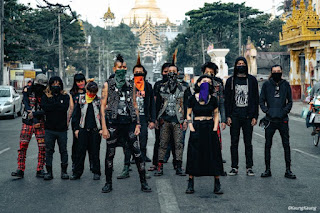
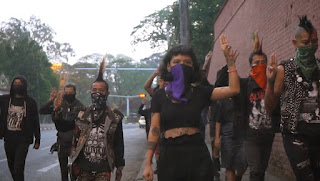
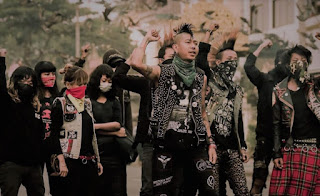
Myanmar also has a committed punk community. The Rebel Riot is one of the most important bands and is at the forefront of the fight against the coup. We had a conversation with singer Kyaw Kyaw.
On the first of February, it was one year ago that the military coup took place. Back then, the military promised to hand over the power to a civilian government after one year, but of course I don’t think this will happen. What do you think will happen?
I think things are well out of hand for them. The revolutionary movement is too strong. After the English colonisation, in 1948, we gained independence. In 1962 the military took the power. In 1988, we had a big revolution, but the military took the power again. After the coup in 2021, things are totally different than in the past. After one year, people are still fighting, and they keep on fighting. The military didn’t manage well. They didn’t get what they want. People fight back in many different ways. People are still protesting, keeping up the Civil Disobedience Movement (CDM), they are fighting with the armed force and so on. Artists and politicians are still showing solidarity with the protest movement. In the past, the military could control any protests after two or three months. This time, they don’t control the land. After one year, the people’s revolutionary mind and spirit are still big.
So you don’t think the military will make any concessions to the people at this point?
No, I don’t think so.
On the first of February last year, you heard about the coup. Was it a surprise for you or not?
I was surprised, but I had also thought before that they would take the power. I was informed, but when I heard they took the power for real, it was a surprise and shock. But that drove us to do something against that coup.
What was your first reaction when you heard about the coup?
I walked around my township and checked about how people felt. A lot of people were chocked and sad. I felt sad too. I didn’t know what to do in the future, with this military system. I was also very sad for the young people and the next generation. These were my first feelings after the coup.
You were one of the first to go out on the street to protest the coup, which started a few days after the coup. How did that go?
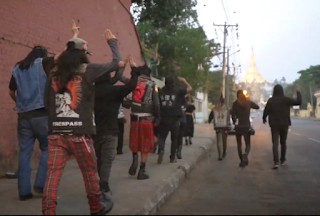
It started on February 5. I’m not an organiser. I just wanted to show my solidarity with other people. I got a message that we should demonstrate at 4 pm in this specific area. I went to support this crew, but the organiser didn’t come. We didn’t know what to do. The media were also waiting. Many other people were there. We were confused. Should we start on our own or just leave? 4:30, nothing happened; 4:45, still nothing. When we left, my friend started showing three fingers on the street (the three finger salute was inspired by the movie ‘The Hunger Game’ and became the symbol of the protests, xk), and then everybody started showing three fingers. The media noticed it. We didn’t talk, we didn’t pull the banner, we just showed the three-finger salute and walked on. A lot of people were happy and were clapping for us. They were applauding from their flats and from the busses.
The media took pictures and made videos. I was so shocked and scared. I didn’t know what to do. A cameraman from the media told me: ‘Kyaw Kyaw, you should leave now.’ I tried to leave. I tried to take a taxi, but the taxi drivers were very scared. They didn’t want to take us because they didn’t want trouble with the police. It was difficult to take a taxi, so we went to another area and took a taxi there, and then went to meet our friends. After this, I deleted my facebook account and I hid myself.
You had to hide? So, you cannot walk freely in Yangon?
If they recognised me or other people in the newspaper, they would arrest us for sure. But we were lucky, because after we went to demonstrate … the next day, a lot of people were on the streets. So, our demonstration disappeared. On February sixth, a lot of people were showing solidarity against the coup. That was good luck. Otherwise, I would have been arrested.
One month after the military coup, you released the video for ‘One Day’. It was a song that you were already working on before the coup. It was a great video, with also the three fingers salute that you just mentioned. What was the impact of that video?
This song was already made before the coup. We imagined … One Day … a future without any discrimination, we don’t want any oppression, we don’t want any military, no corruption, no wars … Because our country has known so many civil wars. We have the longest civil war in the world! We have a lot of discrimination between islam and buddhism, and we have had a military system for so long. From 2010 to 2020, we had so-called ‘democracy’, but people didn’t really have human rights or were not free to speak. In the parliament, the military power was still there. They controlled it from behind the screens.
We wrote this song six months before the coup. But after the coup, we thought it was the right time to release it. We wanted to do it like many political bands like Pennywise, Rage Against The Machine or System Of A Down. They influenced me a lot. We wanted to shoot a video during the protests. But it’s scarier here because they shoot with real bullets. Protests here are different than in other countries. In other countries, the police might beat you and arrest you. But here, they shoot with real bullets.
We were scared, but we had to do it. Everybody was aware of the danger. We asked everyone: ‘does it feel good to participate? If you don’t feel safe, you don’t have to be part of this. If you agree, we will do it together.’ That’s the way we made the music video for ‘One Day’.
The release of the CD ‘One Day’ was delayed because people were afraid to work with you. The printers didn’t want to work on it. What happened?
It was very difficult. We knew that it was risky when we released it. It’s like walking on a string. I think: ‘they do their job, we do our job’. They took the power and try to manage it, and we wanted to release this CD. It’s not just music, it is showing our attitude. They try to show how they control us, and we want to show that we are free. They’re trying to push us down, and we are trying to stand up. That’s how we relate to this idea.
That’s why I wanted to release it, especially during the coup. It is very dangerous, because we sell merchandising and so on … and they don’t want any artists against the coup. I wanted to do a DIY-release, but because of the colours, I could not make a DIY-print. So, we had to go to a printing shop. But every shop said no. They didn’t want to do it because it was political stuff. They were afraid their business would be shut down. But one of my friends who is also a political activist said that he knew one shop who would do it. So that’s how we succeeded in printing it.
But as we keep on doing what we do and keep on fighting, we get less attention than other political leaders and activists. We are punks, we are underground … so we are not so influent to their big society. We influence mainly young people, alternative people, and some political activists. We are not as influential as people like Aung San Suu Kyi. That’s why we stay under the radar.
Is the military aware of the CD with harsh critic of the coup? Does it have any impact for them?
I don’t know. They focus on other protests, political leaders, activists, and they might forget people like us. They are more focussed on others that are maybe more dangerous and more important for them. But we are on their list for sure, I think.
You sing about the protests in ‘The Night Will Not Be Silenced’. At first, the protests were peaceful, as you sing in the song. It was civil disobedience, banging on pans and pots. But there has been an evolution towards a civil war. There has always been a civil war since the independence of Myanmar in 1948, but it has broken out in a much harder way. How was that evolution between peaceful protest and armed protest?
95% of the population hate the military. We have been in a military system for so long. A lot of families have people missing or killed. So, people deeply resent the military. When the military took the power again, this anger was coming back. But we never start the violence. The peaceful protests were right. But the military shot at us, in the head, in the body … So, the anger exploded and people wanted to fight back. Some people don’t believe in peaceful protest anymore. Because even if we stay peaceful, they will never stay peaceful … That’s why a lot of young people, teenage people, a lot of my friends, people whose family or friends died … choose the armed resistance.
They think the Civil Disobedience Movement is not fit anymore. Because the military arrests new people every night. People are not safe. They think the city is not safe anymore. That’s why they choose to go and join the armed resistance. A lot of people are joining the People’s Defence Force (PDF, an armed movement that is active since MAY 2021, xk) and do fight the military with weapons.
The PDF is a new force, but there are also the armies of the ethnic minorities. You sing about them in the song ‘Destruction of Humanity’ …
The ‘Destruction of Humanity’-song is about how the military attacks minorities, burning their houses or villages. We are criticising this.
In a way, you already answered my question. A lot of young people are leaving the city to fight with rebel groups, also ethnic rebel groups or the People’s Defence Force. Is this a big movement?
Yes, it is a big movement. In the past, the Burmese army attacked the Shan people, the Kachin people… Then the Shan and Kachin people fought back. But with the PDF, the Burmese people are attacking the Burmese army. There are now two Burmese armies fighting each other.
And I have heard that the official army – the Tadmadaw – are afraid to leave their barracks. They are attacked at multiple fronts. Is that right?
Yes. They are very afraid right now. They have too many enemies at one time, because the PDF and other groups are all fighting them at the same time. So many people are dying right now. That’s why they are afraid.
Another song on the album is ‘Genocide’. I think this is about the ethnic cleansing of the Rohingya minority in 2016-2017. You said already that muslims are still persecuted. How is the situation with them now?
When we wrote the ‘Genocide’-song in 2018, some people agreed that this was a genocide, but other people disagreed. The government, the NLD (National League for Democracy, the party that was in power between 2015 and 2021, xk), the Tatmadaw … they don’t want to hear about a genocide. They tell us that there was no genocide. That’s why we made a song that was called ‘Genocide’, to stress that it was an actual genocide. We don’t use the word ‘Rohingya’, but we wanted to stress that a lot of people in the Rakhine state were fleeing their houses and dying. Everybody knows that we mean the Rohingya people, right.
Another song is ‘Food Not Bombs’. We are aware of your Food Not Bombs-project in which you distribute food to people in need in Yangon. I’ve understood from your facebook that you also have a Food Not Bombs programme directed to the Rohingya people. Is that correct?
Yes. But we are not in the refugee camps in Bangladesh. Some Rohingya people are still in the Rakhine state (the part of Myanmar where the Rohingya live, xk). We are supporting the Rohingya people who stayed in the Rakhine state.
Yes, but you live in Yangon. The Rakhine state is far away. So, the Food Not Bombs-project must be a big organisation…
No, it is not a big organisation. We have a lot of influence on young people. They like Rebel Riot, and it’s not only about the music. They like our way of thinking, our way of living, they like our ideas … Some fans of Rebel Riot who live in Rakhine state wanted to start a Food Not Bombs-chapter in their own state. Because if you want to support our band, you should not buy the CD or merchandising, but you should just show it through your attitude. That’s how the chapter in Rakhine state started. We don’t need to go there. We can meet with a zoom meeting and share our ideas and brainstorm. We are not only active in Rakhine state. We have chapters in Dawei, Mandalay, Mon state, Bago… Sometimes I go and join, but normally I live in the city. We are now also starting a new chapter in Kachin state. I don’t need to go. I just meet with people on internet and share my ideas.
Let’s go back to the start of Rebel Riot. You started the band after the Saffron Revolution in 2007. You already said that it was very different from now, but the Saffron Revolution was also a big revolution against the military. What differences do you see between now and then?
Back then, the buddhist monks were starting the revolution. We are a traditional buddhist country, so everybody though: ‘they can arrest everybody, but not the monks’. People didn’t expect the military to turn on the monks. Usually, the people are afraid of the military, but now they thought that they were many and the monks supported them. They thought the military could not kill or arrest a monk. They have to respect the monks. But they did not. They shot and killed many people. So, people were very scared. A lot of people died. That made me think and I started making music after that.
What was different is: we didn’t have internet. Well … some people had, like the rich and the government people. But normal people didn’t have much information. We could not communicate. The Saffron Revolution mainly took place in Yangon. The news didn’t go out to the rest of the country. This current revolution doesn’t only take place in Yangon. The whole country is involved.
But especially the information technology is different. Everybody has a phone. We know what happened somewhere after five minutes. This helps us in our fight. The people have more knowledge. They understand what the military is doing. They have a lot of information, and the information goes very fast. This is very different than in 2007. They could shut down everything after only one week back then. But now, we have been protesting for one year and it is still going on. We keep on sharing information. Everybody is awake right now. We are less scared and better educated than before.
We also remember that the Saffron Revolution was leaded by monks. What role do the monks play in the current situation? I think some of them support the Tadmadaw and others not.
Some monks are puppets of the military, as is MaBaTha (a radical right-wing organisation of buddhist monks, xk). They are supporters of the military. They are not talking about buddhism. They are rather spreading nationalist propaganda: ‘we have to fight for our religion, we have to fight for our people’ … They try to brainwash the people. But in these times, many people know their real face. They are not that successful with wat they are doing. But this type of monk had nothing to do with the Saffron Revolution.
We have three types of monks in Myanmar. The first type is apolitical. They are not interested in any politics. They just want to do the meditation, reach inner peace, and spread the buddhist religion. The second type is the pro-democracy monk. These are the monks you saw in the Saffron Revolution. They support the NLD, they support democracy and human rights. They believe that they cannot be in peace if the people do not live in peace. They get food from the people, so they believe they must stand up for the people too. The third type of monk is the pro-military monk. They spread propaganda about how important the army is: ‘In this country, we cannot survive without the military’. They don’t trust Aung San Suu Kyi because she is married with an Englishman. She could bring in English and western influences, so the Burmese people will lose their identity. They think that Aung San Suu Kyi is pro-muslim and will help the muslim community to get bigger. They want to defend their religion and identity. The pro-military monk is represented by MaBaTha.
Sometimes Aung San Suu Kyi is also called a Burmese or Bamar nationalist (the Bamar are the main ethnic group in Myanmar, xk) because she defended the army about the ethnic cleansing of the Rohingya. She even went to The Hague to tell the World Court what happened was just an ordinary armed conflict, not a genocide. Some also say that she didn’t fully support the peace process with the different ethnic armies, which started in 2015, too. Is this true?
You know, most of the people who fight for democracy love Aung San Suu Kyi a lot. Since 1988, Aung San Suu Kyi is the icon of freedom and peace. Some people would even die for her. She has a lot of support. After 2010, we were on the way to democracy, and she was released from house arrest. She had massive support, also from ethnic minorities and from alternative people. They too see her as our mother. After 2015, when she won the elections, the Myanmar people put their hope in her. She was a top politician that had the power, you know.
But she didn’t stand for the students, or for other ethnic groups. She was also very close to the military. She didn’t show enough strength. She only took decisions on things that are not so important. For the people of the big cities, it was a big change. The tourists were coming in, it was good business. Human rights got a lot of attention. The people in the cities love Aung San Suu Kyi a lot. But for the minority people, the civil war continued, the human rights abuses continued, a lot of violence is still happening … She doesn’t speak about them. They don’t hate Aung San Suu Kyi, but they wonder why the mother doesn’t do more for them. They are angry, but still with love for her.
But Aung San Suu Kyi had less power than people believe. People are saying that she did wrong, that she should have created her own army before the coup … They are angry because she didn’t prepare anything. Now, people wish that after the coup and after the revolution, she would retreat from politics.
Let’s go back to the music. I like the way you mix the Burmese language with English in your songs. Why do you do that? You speak Burmese, but you also fit in some words in English in many songs.
It’s our style since we created the band. As we write our music, the choruses are mainly English while the verses are in the Burmese language. We tried to translate it in Burmese, but it didn’t work well. Our English is not so difficult. We use a type of English that everybody understands. We also have international people who support us, and they like it. But I cannot write a full song in English. I’m very bad at singing in English. But even if people don’t understand the whole song, they understand the chorus. The Burmese language is more difficult to translate and more difficult to shout.
I have just one final question. You’re in a struggle with the military, there’s a civil war going on, there is still a civil disobedience movement going on … Do you think the people can win this struggle? Can the people defeat the military?
I don’t know what will happen. I’m not a politician. But I strongly believe that if we fight every day, we must win for sure. Also, we are already winning. People keep fighting and are believing in it. And the military, the Tatmadaw, are scared. Even if they have guns, they still fear us. So, we have already won. We’re doing what we believe in every day. They are doing what they’re fearing every day. We have a lot of artists defying the military. I cannot predict the future, but if we keep doing what we believe in, we will win one day.
Is there anything else you want to say?
It’s not only Myanmar that faces problems. There are problems in every country. But our problems are bigger. People are getting killed. This military must disappear. That is our duty. Don’t look only at Myanmar. We are just a small part of the world. Don’t fight only for Myanmar, but for all people everywhere. We know no nations, no borders. We are one world. If we succeed in our struggle, we will also fight for your part of the world one day. All human people must show solidarity.
25 years, that's how long Ahráyeph has been around. Or rather: in 1996, the first demo of Crucifire, the predecessor of Ahráyeph, was released. In 2021 the ‘XXV’-E.P. was released by Ahráyeph, which had to celebrate a quarter of a century of music by Raf Ahráyeph – Raf Jansen for the friends. We thought this was a great opportunity to review the most important dates from this ‘prog-goth’ career with Raf. We had many questions, and Raf has always answered extensively and remarkably candidly. So it turned out to be a long, but very interesting interview.
1996: You record your first demo for Crucifire, a goth metal band which is a precursor for Ahráyeph. Tell me how that came about?
At that time, I used to live in an old convent, which also housed university students. Among others, Steven Zwaenepoel, now road manager for dEUS, lived there. In 1995, Jo, Crucifire’s bassist to be, got a room in Steven’s hallway for the duration of his nursing apprenticeship. We kept in touch afterwards and because he had told me of his band, Sarcastic, I went to a rehearsal of theirs in the Spring of 1996. They mostly played cover songs, like Therapy?’s ‘Teethgrinder’. I had already laid the initial foundations for Crucifire with a first demo, recorded on an analog four track back in 1995, and was now looking for a band. Jo, playing bass, and his buddies David and Peter were competent musicians, so I proposed to segue their band into mine.
I don’t remember why, but Peter wasn’t part of it initially, so we had a different guitar player for a while. When he failed to show, it turned out that Peter was interested after all. David moved from drums to keyboards and electronic percussion, because I had an amazing drummer in my buddy Geert, who - without wanting to diminish his drumming abilities - outclassed David on that instrument. But David had a lot more qualities: he had a much broader theoretical knowledge and was a multi-instrumentalist, so I really wanted to keep him in the band, even if we already had a keyboard player in Raf Corten, who I later took with me to Ancient Rites.
The six of us then started rehearsing and recorded a first, hideously sounding demo in October 1996. We did parts of that in our rehearsal space and in the loft I had moved to, which has been immortalised as ‘The White Square’. We had really decent recording gear, which is surprising for a fledgling band, but we made up for the lack of recording experience with enthusiasm, with all the hideously sounding consequences.
1996-1997: You start playing in the black metal band Ancient Rites. Is that the reason why Crucifire got sidetracked?
I have to adjust that timeline a bit: I’ve played in Ancient Rites for about six months that first time, from September 1996 till March 1997, with a one-off stand in gig in May, when Erik couldn’t make it to the concert. My addition to that band wasn’t the reason why Crucifire got sidetracked, though, because the band kept existing, albeit less and less as time went by, until early 1998. A couple of the rehearsal demos we recorded during that time, I later crafted into songs that appeared on the first few Ahráyeph releases (e.g., ‘Cure/Divine/Madness’). No, the reason for Crucifire’s slow demise had more to do with the fact that first Jo and then Geert quit, respectively due to studies and work commitments. Hence, they couldn’t dedicate enough time to the band. For a while, that dampened Peter and David’s enthusiasm, but one by one they returned. Raf apparently liked being in Ancient Rites better and started to be absent from our rehearsals without ever giving a reason. He just disappeared at crucial times. This became something of a recurring thing with him, which ultimately cost him his place in Ancient Rites and its side band, Danse Macabre.
Besides all that, our soft drug use, which Geert had brought into the rehearsals, became a big part of the band’s undoing. Rehearsals started to turn into excuses to smoke pot until deep into the night. I wasn’t happy with that, but I didn’t possess the authority to nip it in the bud either, not least because I was a guilty party.
2001: Crucifire dies a quiet death, but around the turn of the century you reboot the project. You change the name to Ahráyeph and steer the ship towards gothic rock, without the metal influences. What was your motivation to start over?
Well, it may sound funny, but that first demo played a big part in that. I met the drummer of a band that often had opened for Ancient Rites. He was a fan of the songs on the demo and sang their praises in the presence of friends of mine, who only knew my alt rock project Sole, so they became curious about what I had done prior to that. However, I was too embarrassed about its bad quality to let them listen to it. Eventually, though, it did happen and one of them, one of the biggest fans of The Sisters Of Mercy I’ve known, was of the opinion that Crucifire was where my heart was at more than those alternative songs. That made me think, and after a couple days of brainstorming, I decided he was right and rebooted Crucifire. Still a while later, I changed the name, because I indeed wanted to expel the metal influences present in Crucifire. Not that I suddenly resented metal; I was just looking to conceive a more organic, open sound, with more atmosphere. Besides that, an Australian thrash band who used the same name had come into existence in the interim (they are no longer active). And lastly, I was the only remaining original band member, so it was an easy decision.
2004-2007: You once again become a member of Ancient Rites. You’ve contributed significantly to this band in this period, especially as a song writer on the ‘Rubicon’ album. In 2007 you leave Ancient Rites to concentrate on Ahráyeph. What do you remember about your time in the band?
Oh boy… You got a couple of hours? A lot happened back then, both good and bad. To keep it positive: we’ve played several great gigs. There was the Revoltallo XIII festival in Vigo, Spain, where we played on a mountain which looked out over the bay where the city lay. A beautiful spot, which had a restaurant nearby which was situated under a large rock. Fascinating. The audience was truly amazing that night. I had contracted a twenty-four-hour flu from the air conditioning on the plane and played with a fever, but the audience was so riled up they really pulled me through with their unbridled enthusiasm.
I also met Marec in the band, who had recently become their sound engineer. He would also come to fill that position in Ahráyeph. A wonderful human being who knew his craft inside and out, to both bands’ advantage. Unfortunately, he got diagnosed with Meunière’s Disease shortly before the pandemic hit, which is causing him to lose his hearing. A serious loss, both for Marec and the bands he worked with. But the comradeship remains, even if we don’t talk very often. He even came and helped me out with the renovations here for a few weeks right before the pandemic hit, just out of kindness. He’s contributed so much to Ahráyeph, more than many an ex-band member, so I would be remiss if I didn’t mention him.
Our gig at the Graspop Metal Meeting in 2006 was of course also a personal high note. I’m a full blood Kempian (Kempen being the Belgian geographic region where the festival is held annually), so being able to play in your own region at the biggest metal festival in Belgium and one of the biggest in Europe, couldn’t be anything else than a high note. Musically, it may not have been our strongest concert, no doubt due to raging nerves, but the Marquee was packed to the rafters, all the way to the outside, I was told later, and we got an amazing reception. There were also friends and acquaintances in the audience, which made it extra special. Other than that, our backstage trailer was across from Alice In Chains’, who are musical heroes of mine. I was able to exchange a few words with Jerry and Sean, very nice guys. But the most rock ’n roll moments of my life happened when I went to the toilet before our gig and ended up standing at the urinals between their singer William DuVall and the New York Dolls’s David Johanssen. Then you know you’ve arrived, hahaha!
Another high point was of course the album ‘Rubicon’ itself. I’m still immensely proud of that album. It’s true that the music for most of the songs was written by me, but Erik’s songs and ‘Brabantia’, which I co-wrote with Domingo are just as strong. There are no weak songs on that album. And it also contains some of Gunther’s strongest lyrics. I recall that Erik and I went out for a drink one night during the recording process, because we needed a break and during the ride into Krefeld, we agreed that we had a strong album on our hands. This was evidenced later when the invariably positive reviews started coming in. That’s also the reason why I stayed in the band longer than I intended, as after the record was finished, things were said and done to which I took great exception, but I just couldn’t detach myself from those songs. Let’s call it vanity…
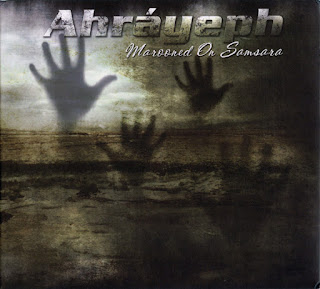
2008: it’s finally here: ‘Marooned on Samsara’, Ahráyeph’s debut. I’ve come to understand it was a difficult undertaking, because even though you had a band, you’ve recorded a lot of it by yourself. How happy were you with this album?
I was happy that the album was released and got the opportunity to do so via D-Monic. Contrary to what you often hear, I’ve never had any complaints about the label that released ‘Samsara’. They’ve always treated me fairly and stuck to the contract and the agreements we made. It’s just unfortunate they weren’t able to provide tour support because they weren’t big enough to do that. I’m sure they would have if they could have. That could’ve made a difference.
2008: I’ve only seen you live once, at a gig promoted by Bunkerleute at the Lido (Leuven, BE). You still had a band back then, now you’re doing everything on your own. Is there still a chance you’ll be playing live again with Ahráyeph?
That chance is definitely still there, but unfortunately, with the times being the way they are, it’s not the right time to start organising that. I’d have to find new musicians to accompany me, organise rehearsals, find a booking agency… As long as the pandemic rolls on and the uncertain times for artists continue, I don’t think it’s the right time to put all of that in motion, even if the desire to play live definitely exists. I’ve not played live for much too long and it’s something I always loved. After my first European tour with Ancient Rites, I knew I was born to be on the road, as exhaustive as it can be. I came back from that tour completely drained, but after just one night’s sleep in my own bed, I was ready and willing to jump back on the tour bus and do another ten days straight. That says it all. I come alive when I’m onstage, even if I don’t talk much or at all between songs. That’s not arrogance: my songs are my way of communicating with the audience, what more do you need to add to that? But I’d really love to do that again. If there are any interested musicians out there: you can always contact me through the band’s official Facebook page.
2013: You get the diagnosis of having Autism Spectrum Disorder. On the one hand, you’re extremely intelligent, on the other you have issues with things that are mere afterthoughts to the average person. Do you think this disorder had an impact on your work with Ahráyeph?
Without a shadow of a doubt. Everything I do, right or wrong, is being determined by my disorder. It’s only when I got that diagnosis, that I started to realise how deep the impact of it has been on everything I’m doing and everything I’ve experienced.
Allow me to say that I think it important to be open about my A.S.D. Some people, even fellow musicians, have tried to pressure me and told me I shouldn’t, but especially in times like these and after everything I’ve been through, it’s important to me to be able to be who I am. And I’ve also always supported other people in their quest to be who they are. I was bullied in high school, my family looked down on me… I ended up with bouts of prolonged severe depression and an extremely negative self-image because of that; I constantly hit the walls of my own boundaries, I was (and still am) considered a weirdo because I react in a raw and unfiltered way to everything, something I still often do because unfortunately, it’s beyond my control. I’ve been hurt, but I also have hurt, sometimes without realising just how much. There are certain relationships where, in hindsight, I have to admit I can’t hold it against those women that they ended them, because due to the combination of my autistic nature with those depressions and their ensuing self-esteem issues, I treated them less than they were worth. At the same time, I’ve also been easy prey for women who didn’t have my best interests at heart, due to my A.S.D. That’s how a song like, say, ‘Lilith’ came into being. Since my diagnosis and the therapy going along with it, I’ve become (more) aware of my own shortcomings, but just as well of my own boundaries, and that helps. Ahráyeph, in that sense, has always been an outlet for all these autistic experiences and observations. Ahráyeph is my self therapy. I certainly am not the only one in the music scene in that respect. And speaking of that self-esteem : it’s a lot better now. I don’t hate myself anymore, but the emotional damage I’ve accumulated over four decades has left an indelible imprint on me. It can’t be helped, but fortunately, I have Ahráyeph to help me deal with that.
Practically speaking, my A.S.D. has also interfered with Ahráyeph and cost me many an opportunity, because I am, after all, who I am and the disorder is an integral part of my personality, even if I am, obviously, more than just my disorder. I am simply unable to turn it off. It’s always there and that’s often tiring, even for me. And when it comes to interpersonal dynamics, it’s never easy to deal with other people. I’m extremely detailed and hence very verbose (for example: it’s not easy for me to keep my answers to your questions concise, because I want to paint as detailed a picture as possible, which is, of course, impossible), am always striving for perfection and hence am not making it easy on myself as well as others. And at the same time, I have zero tolerance for laziness, manipulative behaviour, and selfishness. When it comes to band dynamics, those were too often the causes for rifts, not just in Ahráyeph, for that matter.
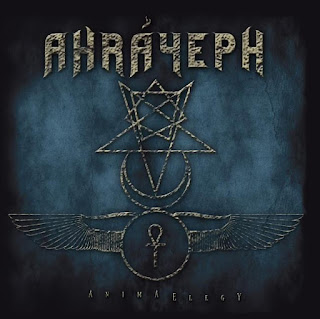
2015: It takes seven years before there’s a follow up to ‘Marooned on Samsara’, a delay caused in part by a serious burn out. Nevertheless, ‘AnimAElegy’ is a real gem. This time you record everything yourself, except for guest musicians on drums and keyboards. Are you still proud of this album?
Definitely. I have to correct you, though: Ness was not a guest musician, but a band member in Ahráyeph’s last live line up. It’s too bad she, too, had to give priority to her job, because she was without a doubt the Ahráyeph band member who meant the most to me, both on a personal and a musical level. I still miss working with her.
Getting back to ‘AnimAElegy’ then, I feel that it’s a step up from ‘Samsara’, even if my observation is that the debut struck a chord with a few people, more than this album or the releases that followed. Even so, when it comes to song writing, production and also lyric writing, I’m more than happy with ‘AnimAElegy’. Aside of ‘Desert Songs’ - which apparently is too long - all of my albums, E.P.s and songs are now on all streaming services, which makes me hope ‘AnimAElegy’ can burrow its way into the dark hearts of listeners a bit more that way, because I really think it deserves it.
2016: You release the 'Desert Songs'-E.P., building on the work of Robin Proper-Sheppard - a man who you happen to know personally - and his band The God Machine. Can you elaborate on the inspiration behind the ep?
I wouldn’t say I was building on Robin and his previous band’s work necessarily with this E.P. The God Machine are, as you know, a big influence of mine, but I’ve only borrowed that title, because when I was writing the songs, they evoked a desert like atmosphere in me. My mother, who is by no means a fan, observed a couple of times that I ‘write cinematic music’ and when it comes to ‘Desert Songs’ in particular, I do agree with that assessment. While I was composing, I kept envisioning scenes of big sand dunes, red evening skies with a sun setting on a horizon trembling from the heat, caravans ploughing through the sands, trying to reach an oasis and nightly desert skies lit up by stars and planets.
On the other hand, I was living through that burn out you just mentioned at the time. How I felt back then was described perfectly in the title track of prog metal band Queensrÿche’s fifth album, ‘Promised Land’: ‘Life’s been like dragging feet through sand and never finding a Promised Land’. Queensrÿche may at first glance not be a band you’d listen to as a goth (even if ‘The Mission’ and ‘Suite Sister Mary’ on ‘Operation:Mindcrime’ are early examples of what later would become ‘gothic metal’), but this album has a very dark and sullen vibe. It’s more Pink Floyd than heavy metal, but that makes the album all the better to me, and the title track is really very dark and depressing. Everything being described in it could have come from my own life back then, so that came to mind when I was working on ‘Desert Songs’. Thanks to the image of someone ploughing through sand and not getting anywhere, I got the idea to use that title and write lyrics in the same vein, which was surprisingly easy. I feel they are among my best lyrics, if not my best. The book ‘What Dreams May Come’ was also a source of inspiration. I remain convinced it also was the main inspiration behind Carl McCoy’s lyrics on the Fields of the Nephilim album ‘Elizium’. I had just reread the book and was riffing on the concept of the ‘Summerland’, the dimension in between death and the next reincarnation, so that’s part of it as well.
2016: With ‘Desert Songs’ you also announce a temporary hiatus to Ahráyeph. You want to concentrate on your metal project, Trans World Tribe, with singer Staci Heaton. The band releases an E.P. and a single in 2016, but fades into obscurity thereafter. What happened?
In short: just like Ness, Staci decided to give priority to her career. She works for the Californian government, where she is part of the environmental and agrarian department. She’s also married (her husband Brian recently co-authored the very first biography on the aforementioned Queensrÿche) and is raising a daughter. That all these things take precedence over a music project is something I completely understand. On the other hand, she’s a very talented singer and it’s a pity I can also no longer work with her. But Trans World Tribe isn’t dead, just hibernating. I don’t yet know when or how, but there will be a follow up. I still have plenty of demos and song ideas lying around to work with, so there’s no shortage of material for the future.
2018: You release the ‘Heavy like the ancient sun’ album, an homage to your deceased friend James Blaast!™. What was your motivation behind that?
James was, without exaggeration, my best friend. Our friendship was completely mutual, something I can’t say of many other people. It’s hard to explain why our friendship was so special… It just clicked from the first moment we met. It was as if we’d known each other our entire lives. That in itself wasn’t obvious, because as everyone who knew him can attest to, James wasn’t always the easiest person to get along with. He was very outspoken and didn’t mince words to the point where if his words had actually been meat, he could provide the whole of Scotland with prime, unminced beef for years. He also had no issues writing off people when he was done with them for whichever reason. Even I butted heads with him a few times because he crossed the line. But contrary to where he’d stick to his guns with other people, he’d always make the effort to make amends and respect my boundaries. He even told me so in no uncertain terms the last time this happened, and he kept that promise until the day he died. That’s the way he was. On the other hand, James was the most loyal friend a person could’ve had. He never thought twice about giving me a Facetime call and if I took too long to do so myself, I’d get a good natured ‘ERSE!’ in my mailbox, signalling it was high time for me to return the favour. Those calls turned into one- or two-hour conversations, sometimes twice that.
He also was very patient with me. If, for example, I had a bad day and kept that from him, he wouldn’t say anything about it, but, almost always successfully, tried to make me laugh, after which he subtly - yes, he could be subtle - let me know he knew something was wrong with me. The man knew how to handle raising my spirits without being intrusive. That’s real friendship. I thought I knew a lot when it came to music, but James, generous as he was in sharing his musical knowledge, taught me a lot more still. His knowledge of music was vast and his love for music even greater. It was all encompassing, especially where it concerned prog rock, goth and metal. The fact that I know Chameleons’ ‘Script Of The Bridge’ is entirely his merit, because this band wasn’t on my radar back in the 80’s.
He also was a graphic designer, something I later became too, in part due to the things I learned from him. I owe my diploma in part to him. He also managed to pass on his love for his hometown, Glasgow, to me. I love that city; I love its mentality and the people who live there and its good and bad aspects. James and I always addressed each other in ‘Weegie’, the Glaswegian accent, which I’ve since made my own, even if my command of it may have waned since I’m unable to talk to James anymore, like we did up until two days before he died. James was my brother from another mother and he and his mum Molly, who died about eighteen months after him, were fantastic people to have known. James also was Ahráyeph’s No.1 fan. It was he who bestowed the ‘prog goth’ label on Ahráyeph. He even came to Belgium to attend Ahráyeph’s very first live gig. His support was unconditional, even if he could be critical when he felt it was needed, which was also something I always appreciated. So why would I not honour his memory in a way he would have found fitting, with music?
2018: You release a reworked version of ‘Marooned on Samsara’ digitally. All songs were re-recorded. Were you that dissatisfied with the original recordings?
I was, actually. In the interim, my knowledge of music production had improved exponentially, and I also had better tools to implement them. I’m speaking in particular of the speakers I was using, the right studio speakers, which are different from hi fi speakers, make a huge difference. It’s something I learned empirically. All of a sudden, I didn’t have to work as hard to get a good mix, because I had a clearer sonic picture to work from. Additionally, the CD version of the album was sold out and no longer available. This made me feel it was the right time to re-record it and right a few wrongs. On top of that, I had a run in on Youtube with an American publishing company who, as part of my deal with D-Monic, had gotten their hands on the rights to my songs for the duration of the contract. I was warned I had no right to publish my own songs on the platform. Even though the rights reverted back to me after three years and I once again retained full ownership to the songs, I felt it prudent to re-record the album and re-register the songs, so I would keep the author- and publishing rights, so things like that would never happen to me again. People seldom realise it, but there’s a lot of administration involved when it comes to making music professionally, and if you’re not careful, there can be big consequences.
2020: You announce the ‘Heaven No. 7’-E.P. as an inbetween release to make up for the long wait for the next album. I do like it, and was especially impressed by the profound lyrics. Can you tell me how you handle writing lyrics for Ahráyeph?
Ooff, that’s a question that often gets asked, just like ‘how do you write your songs?’, and for which there is no simple answer, really. As I’ve already mentioned, my lyrics deal with my own experiences and observations. I would, however, like to write something from a different perspective down the line, even something fictional and I already have come up with a few ideas, which may even be used for Trans World Tribe, but in Ahráyeph, I mainly am addressing my own life and emotions, not least because, as I mentioned before, Ahráyeph is my outlet and therapy.
Something I do try to avoid, is to become political in my songs. I did make an exception to that rule during the repulsive Trump era and the events of January 6th. That’s how the song ‘Superspreaders’ ended up on ‘Heaven No.7’. The man is Roman emperor Nero incarnate and you can take that literally. Anyone going through the effort of checking out the Wikipedia page on that emperor can’t get around the often shocking similarities. Only, Nero didn’t have social media to spout his poison. But other than that, you shouldn’t expect any politically inspired songs from me, except if there would be a neo nazi and fascist takeover in this country and in Europe. That must be resisted by any means, even musical ones.
What’s always been really important to me where Ahráyeph’s lyrics are concerned, is that they work. I have a very allegorical and metaphorical style of writing, often laced with references to other songs, authors and metaphysics. That’s not just due to my literary and musical influences, but also to me not being good at writing ‘direct’ lyrics, in which I express myself in a more explicit manner, like, for instance, Robin Proper-Sheppard. If I write like that, it ends up in clichés and schmaltz and it ends up sounding fake. Whereas when he does it, I instantly believe what he’s singing. I once told him I consider him an impressionistic writer, both in the God Machine and in Sophia. It’s a craft and he possesses that craft, I don’t. Furthermore, I just don’t want to be a copy of anyone else. I’ve searched long and hard to find my own literary ‘voice’, another reason why that Crucifire demo makes me break out in hives of shame, because those lyrics were, for the most part, really bad, with a few nuggets here and there. The irony of it all is that, right after I finished that demo, I did start finding that unique literary voice to express myself through. It still wasn’t easy, but at least I found the right angle to express myself in my very own way.
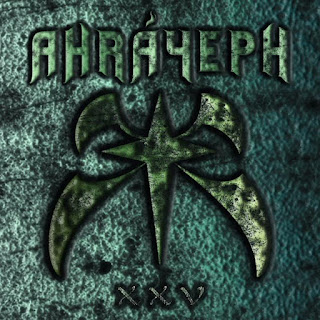
2021: The ‘XXV’-E.P. is supposed to celebrate 25 years of Ahráyeph. It contains three songs, a Depeche Mode cover among them. How important was it for you to celebrate this symbolic anniversary?
A little, haha. Twenty-five years is a milestone, and it doesn’t suck to emphasise that, does it? It doesn’t really feel like twenty-five years to me and to be honest, it’s not as if I’ve had it on my mind for this entire year. It’s just that by the end of last Summer, I looked back on my career and realised it’s been twenty-five years since Jo, Peter, David, Raf, Geert and I got together in that rehearsal shack to become a band and work on songs together. That made it easy for me to couple the release of the ‘XXV’ E.P. with it. Also gave me an easy title, haha.
One constant, from the Crucifire demo to that E.P., is that I’ve always recorded cover songs. At that time, it was an English version of the song ‘Laatste Woorden’ (‘Last Words’) by Belgian band De Lama’s, retitled ‘The Hand That Feeds’, for which I wrote completely new lyrics and which I reworked as if it were a Type O Negative song, until now with Depeche Mode’s ‘Never Let Me Down Again’; because I always wanted to cover one of their songs (‘Stripped’ got discarded because I just couldn’t hear myself sing ‘Let me hear you make decisions without your television’ seriously). And since that song had a personal connotation for me, it was an obvious choice, even if I did manage to put in a few musical references to ‘Stripped’ en ‘Clean’ at the end. Funny thing : it was my cover of The Cure’s ‘A Forest’, conceived during the latter Crucifire days, which lay the foundation for what later became the ‘Ahrayeph sound’. The way I arranged it was kind of a light bulb moment which I would use to my advantage from then on, even if it has evolved over the years, because I don’t want to repeat myself.
2021: You release the single ‘Bloodletting’ with the promise to release a song from the next record each month. That didn’t prove feasible, but we’d love to hear about the new album you’ve been announcing for a while…
To be clear: those monthly releases were intended for the monthly ‘Bandcamp Friday’ initiative, which ran until May. But I did indeed struggle with the lyrics and was forced to postpone ‘XXV’s release, which turned out to be for the better in the long run.
As for the fourth album… It’s a bit of a tough one, because I wanted to approach it from a different angle than I usually do. I’ve got a certain concept in mind which I don’t want to disclose much about right now, but it requires me to write all of the lyrics before getting to the music. It’s not the way I work usually, even if there are plenty of Ahráyeph songs which had lyrics before I wrote the music. However, doing that for an entire album doesn’t seem to be all that straightforward, at least not to me. I’ve been struggling with it for a few years now and that’s also the reason why I’m releasing all those E.P.’s: if I’m sitting on songs that don’t fit the concept but are too good to save up for an album, I’d rather release them. Also, and I hate saying this because I love albums; but the album format is gradually losing its importance. Music these days is being - I’m this close to gagging - ‘consumed’ in a more fragmentary manner. Of course, true music lovers, who luckily still exist, will take exception to this statement because they don’t listen this way, but unfortunately, they’re the minority. That’s just the reality of it. I can’t release CD’s or vinyl albums for that minority because it would amount to a huge financial loss, not least due to the lamentable ‘renumeration’ streaming services ‘pay’ artists. It’s less than peanuts. Only Bandcamp, the platform I’m using to release my music, is treating artist fairly. Hence, it’s becomes important for artists to regularly release music and stay relevant and in the public eye, especially during a pandemic like this.
In the meantime, I’m continuing work on the album - I’m currently on hiatus due to my annual ‘hibernation period’ - but I can’t and won’t make any predictions about when it will be released at this moment. Just a few weeks ago, I think I’ve finally found the right way to open the story with and that’s been the thing I’ve been struggling with the most, because I already have several other parts written for other songs. But due to the nature of this concept, it’s essential that I start with Song One and finish with the last song, in order to keep things transparent and orderly for me. But it’s anything but simple, for me anyway, so I’d rather not say anything about it until it’s (nearly) done. But it will eventually be finished and released, that’s for certain, even if there will still be another E.P. coming soon.