Dark Entries is an independent Belgian music webzine with a focus on dark sounds. The webzine itself is completely in Dutch and can be found at www.darkentries.be. This blog was created with the intention to have an additional online place where our editors can post their English articles.
With ‘Under The Falling
Stars’, The Breath Of Life has delivered a fantastic album. They think so
themselves, by the way, as we found out in a conversation with Isabelle (vocals),
Phil (guitar) and Didier (bass) about the album and all the things that
accompany it.
'Under The Falling Stars' is the 8th studio album of The Breath Of Life. I think it's one of the best.Did you intend
to reach this high with this record?
Phil : We have always
tried to give the best for each record, but there are some things that you do
not always control. I think that in this case everything was right to get
a good result. In the past also, we never agreed about a certain goal. We
just made it happen. This time, we made recordings and nobody heard the
results before we sent them to Gilles Martin in France. When he informed us
that ‘your record is a blow’, we knew were not mistaken. What a relief!
Isabelle : Thank
you. We always give the best for each record. Certainly we would like
to play more. Sharing this album and making it live on stage is very
important to us.
For
this record, Philippe Mauroy played the guitar and Didier Czepczyck the bass.We have noticed
that they both master the two instruments well, and that they often change from
instrument on stage.Has the choice to play only one instrument per
musician contributed to the coherence of the record?
Phil : I have been
absent from the group for a number of years. When I came back we had to
ensure some performances. During my absence, the group recorded two
records with Didier on guitar. Initially, Didier played guitar on his own
songs, all the more because we had a very different style and that I could
hardly play his pieces. (Laughs) Afterwards, it seemed better that each
one would retain a preferred instrument. It must be said that Didier
excels at the bass and really gives a beautiful colour to the songs. As
for the guitar, I let you judge yourself.
Didier : I really think
that if I and Phil had to alternate the guitar, this would have reduced the coherence
on the record to zero. Phil reminds me of the more excited moments of Jean Marie
Aerts in TC Matic. And if he plays a bit softer, he has the romantic
tendency to stroke his strings like Justin Jones of And Also The Trees. I
am - at my modest level - more in the league of Billy Duffy or John Mc
Geoch. Actually, I believe that two guitarists can quickly become as problematic
for a group as having two singers. For example, I'm a big fan of Depeche
Mode, but if Martin Gore takes over the vocals from Dave Gahan, I like it less.
Giovanni
Bortolin, on the other hand, continues to combine the violin and the keys. I think
his violin is well represented on the new record and is giving much identity to
the group.What
do you think?
Phil : Absolutely, it's
an essential element. We can hardly think of The Breath Of Life without
Giovanni and his violin. I do not know how it's with you, but personally
I've never heard anybody like this violin. Together with Isabelle's song
this is probably what the listener most notices about The Breath Of Life.
You've
released two amazing videos with songs from 'Under The Falling Stars'.How did that
happen?
Isabelle : We are lucky to
be able to have the highly talented Jean-Gérard Dermine among our close
friends. He is very open and very creative. His talent and his
ability to bring things to a good end is impressive. And he is still
working to prepare new surprises!
Phil : Indeed. It
is our friend Jean-Gérard Dermine who has provoked this all. For 'Crime
Passionnel', he asked a couple of tango dancers and a few figurants to
participate. For 'Blackout', the setting of the Cockerill framework in
Charleroi was sufficient.
The lyrics in your songs seem to emphasize the flight in dreams.Is this theme
dear to the band?
Isabelle : Dreams are
fundamental and help me to progress. I regularly notice that I am
daydreaming. I love it. In addition, I cut several themes on this
album, such as psychic manipulation on ‘Hide’, Malala Yousafzai's tragic story
on ‘Blackout’, the interaction between feelings, thoughts and deeds in 'A New
Reality', the importance to take distance and take a view from above to
understand more complicated situations in ‘Higher’...
The
cover of the CD shows a photograph of a boat stranded on a beach, taken by the
extraordinary photographer Xavier Marquis.Why did you choose this picture?
Phil : Because of the
atmosphere. I immediately felt a harmony between our music and the lyrics
of Isabelle. And also with the title she had chosen for the record ('Under
The Falling Stars'). Imagine that this boat stranded on an evening, under a sky
full of stars. Don’t we all hide a dark side and a certain disgust under a
beautiful appearance?
Isabelle : The photo was
taken by Xavier Marquis, yet another person with a lot of talent who is passionate
about his art.
Your
new CD is a collaboration between Wool-E Discs and your own Music Language
Records.Why?
Phil : It's the first
time we publish a record ourselves, just because we noticed that the role of a
record label has changed dramatically. In the past, they did everything
they could to release our records, but today, such traders are no longer
available. Only a few fearless people like Wool-E Discs continue to
provide courageous resistance, out of passion. Everything is done via the
internet, and at our level, labels have become a meaningless intermediate level.
In
the past, you have released albums on labels like 'Hall of Sermon' of Lacrimosa
or 'Danse Macabre' of Das Ich.Do you still have ties with these labels?
Isabelle : Surprisingly,
Bruno Kramm of Das Ich asked us - 15 days before the Wave-Gotic-Treffen in
Leipzig - to play as a main act on one of the WGT's podiums.
You
also release a limited edition of the record on vinyl, next to the CD.Unfortunately,
it will contain only 8 out of 11 numbers due to lack of space.Why this choice?
Phil : As you indicate,
this is due to the limited possibilities of a vinyl and therefore not a real
choice. It would be technically possible to put more songs on the vinyl,
but that would have been at the expense of sound quality. So we have deleted
three songs. That vinyl is a gift we have given ourselves.
Do
you want to add something else?We give you the last word.
Phil : We do not need a
label anymore, but an effective booking agency for performances would be
welcome. The call has been made...
Avec ‘Under The Falling Stars’, The Breath Of Life a produit un nouvel
album fantastique. Ils en sont convaincus eux-mêmes, comme nous avons pu
constater dans notre entretien avec Isabelle (chant), Phil (guitares) et Didier
(basse) sur l’album et toutes les choses qui l’entourent.
‘Under The Falling
Stars’ est le huitième album studio pour The Breath Of Life. Je pense que c’est
l’un des meilleurs. Aviez-vous l’intention de frapper fort avec ce
disque ?
Phil : Nous avons toujours essayé de donner le meilleur de nous pour chaque album
maisil y a des choses que l’on ne
maîtrise pas forcément. Dans ce cas, je crois que les éléments étaient réunis
pour que le résultat soit bon.Comme toujours nous n'avons pas discuté d'une direction à prendre, nous
avons vraiment laissé les choses se faire. Nous avons fait les prises de sons
nous-mêmes et personne n'avait entendu le résultat avant que nous les envoyions
à Gilles Martin pour le mixage en France. Quand il nous a envoyé un message
disant « votre album est une tuerie », ouf, on savait qu'on ne
c'était pas trompé.
Isabelle : Merci.On espère toujours le
meilleur pour chaque album.Ce qui est
certain est que nous aimerions jouer davantage.Partager ce nouvel album et le faire vivre sur scène est important pour
nous.
Pour cd disque,
Philippe Mauroy joue la guitare et Didier Czepczyk joue la basse. Nous avions remarqué que chacun
de ces musiciens joue très bien les deux instruments et les échangent souvent
sur scène. Est-ce que le choix pour jouer seulement un instrument par musicien
a bénéficié à la cohérence du disque ?
Phil : J'ai été absent du groupe quelques années et lorsque je suis revenu,
nous avons dû assurer quelques concerts. Pendant mon absence, le groupe a
enregistré 2 albums avec Didier à la guitare. Dans un premier temps Didier a
continué à assurer la guitare sur ses morceaux en live. D'autant que nous
n'avons pas le même jeu et que j'avais un peu du mal à les reproduire
correctement. (rires)
Par la suite il nous a semblé plus intéressant de garder chacun un
instrument de prédilection. Et il faut dire que Didier assure merveilleusement
à la basse et donne vraiment une belle couleur aux chansons. Pour la guitare, je
vous laisse juges.
Didier : Je crois sincèrement que, si Phil et moi, avions alterné les parties de
guitares, cela aurait nui à la cohérence de l’album. Phil, dans ses moments
d’énervement, me fait un peu penser à Jean Marie Aerts période « TC-Matic ».
Et quand il se fait plus doux, il a cette façon romantique de
caresserses cordes à la manière de
Justin Jones de « And Also The Trees ». J’adore mais je n’arrive pas
facilement à faire pareil. Je suis plus, à mon humble niveau, dans la mouvance
Billy Duffy ou John Mc Geoch. En fait, avoir deux guitaristes dans un groupe
peut vite devenir aussi problématique que d’avoir deux chanteurs. Par exemple,
je suis grand fan de Depeche Mode, mais quand Martin Gore pousse la chansonnette
à la place de Dave Gahan, j’aime moins.
Giovanni Bortolin,
lui, continue à combiner le violon et les claviers. Je pense que son violon est
bien mis en évidence sur le disque et est un atout qui donne beaucoup
d’identité au groupe. Qu’en pensez-vous ?
Phil : Bien sûr, c'est un élément essentiel. On imagine difficilement TBOL sans
Giovanni et son violon. Je ne sais pas vous mais personnellement je n'ai jamais
entendu un violon utilisé de cette façon. Avec le chant d'Isabelle c'est sans
doute ce qui marque le plus l'auditeur.
Vous avez sorti deux
superbes vidéos pour des morceaux du disque. Comment vous y êtes-vous
pris ?
Isabelle : Nous avons beaucoup de chance de compter parmi nos amis proches, le
talentueux Jean-Gérard Dermine.Il est
très ouvert et très créatif. Son talent et sa débrouillardise pour réaliser le
tout est assez spectaculaire.Il est
d’ailleurs occupé à nous préparer de nouvelles surprises !!!
Phil : C'est un ami, Jean-Gérard Dermine, qui nous a concocté ça. Pour
« Crime Passionnel », un couple de danseurs de tango est venu pour y
participer ainsi que quelques figurants. Pour « Blackout », le cadre
du Rockerill à Charleroi se suffisait à lui-même.
La thématique des
chansons accentue beaucoup la fuite dans le rêve. Ce thème est-il précieux pour
le groupe ?
Isabelle : Le rêve est fondamental et m’aide à aller de l’avant.Je me surprends régulièrement à rêvasser.J’adore ça.En outre, j’aborde plusieurs thèmes sur cet album, tels que : la
manipulation mentale dans «Hide», l’histoire tragique de Malala Yousufzai dans
«Blackout», la rupture totale d’une personne vis à vis de sa passion dans
«Crime Passionnel», l’interaction entre le sentiment, la pensée et l’action,
dans «A New Reality», l’importance de prendre du recul et de la hauteur pour
tenter de mieux comprendre des situations difficiles dans «Higher» …
La pochette montre une
photo d’un bateau échoué sur la plage, prise par l’excellent photographe Xavier
Marquis. Pourquoi avez-vous choisi cette photo ?
Phil : Pour son atmosphère car j'ai ressenti une concordance avec notre musique
et les textes d'Isabelle. Et puis aussi la relation avec le titre de l'album
qu'elle avait choisi (Sous Les Etoiles Filantes). Imaginer que ce bateau s'est
peut-être échoué, un soir, sous un beau ciel étoilé ? Sous une belle
apparence, n'avons-nous pas aussi un côté obscure et une tristesse enfouie?
Isabelle : C’est une photo qui a été prise par Xavier Marquis. Une autre belle
personne avec beaucoup de talent et passionné par son art.
Votre nouveau CD sort
en collaboration avec Wool-E Discs et votre propre label Music Language
Records. Pourquoi ce choix ?
Phil : C'est la première fois que nous autoproduisons un album. Simplement
parce que nous avons remarqué que le rôle des maisons de disque ou labels avait
bien changé. Avant ils se démenaient pour vendre votre disque mais aujourd'hui
les disquaires n’existent pratiquement plus. Seuls quelques irréductibles comme
« Wool E Disc » survivent par passion. Tout se fait par internet et,
à notre niveau, les labels sont devenus un intermédiaire inutile.
Dans le passé, vous
avez sorti vos disques sur des labels comme Hall of Sermon de Lacrimosa et
Danse Macabre de Das Ich. Vous avez encore des liens avec ces maisons de
disques ?
Isabelle : Quinze jours avant le « Wave-Gotik-Treffen Festival » de
Leipzig, Bruno Kramm de Das Ich est venu nous chercher pour jouer en tête
d’affiche dans une des salles du « WGT ».
A part le CD, vous
sortez aussi une version limitée sur vinyl. Malheureusement, vu la capacité, le
vinyl contient seulement 8 des 11 chansons. Pourquoi ce choix ?
Phil : Comme vous le dites, c'est pour une question de capacité et pas vraiment
un choix. Mettre plus de titres sur le vinyle aurait éventuellement été
possible mais cela aurait nui à la qualité sonore. Nous avons donc dû enlever 3
morceaux.
Le vinyle est surtout un petit cadeau qu'on s'est offert.
Vous voulez encore
ajouter quelque chose ? Nous vous donnons le dernier mot
Phil : Nous n'avons plus besoin de label par contre une agence de booking
efficace pour les concerts serait la bienvenue. L'appel est lancé ... Photos: Xavier Marquis The Breath Of Life
In
these modern times, everything is possible, also and especially in the musical
field. Whereas in the past, the recording of a studio album required the
physical presence in the same space of all people involved, this is no longer
necessary thanks to the ever-advancing technology. Damage Control is a global
electro/industrial project and you can take this literally. 2 of the band
members live in Australia;
the other 2 in
Europe (United Kingdom and Germany). For
the recording of their debut album 'Ultranoia', they have asked even more
international friends for help, among others the legendary Chris Peterson
(known for his work for among others, Front Line Assembly and Decree, and more
recently Ohm) and the equally legendary Claus Larsen (Leæther Strip). Such a
thing is destined to set off fireworks, and as you will read further in this
review, that is also effectively the case.
Bill Barsby, Damian Davis, Jason Podmore and
Markus App are all four experienced musicians and are influenced by a wide
array of artists, among others Front Line Assembly, Skinny Puppy and Ministry. There
are of course hundreds of electro bands that cite these legendary names as
influences, but in the case of Damage Control, this is not an empty statement. Anyone
who listens to their debut immediately makes the connection with FLA and co. Powerful
old-school electro/industrial, characterized by tight production, mixing and mastering
(and that is really not only the merit of Chris Peterson, who was behind the
knobs when this album was recorded). These men know very well what they are
doing.
From the opening track 'After The Fire', it is
clear that this is serious. Especially the first half of the CD is cast-iron,
with the firm 'Hate Crime' (a potential electro club hit) and compelling 'City
Of Ruins' being
my favourites. I am also really captivated by the atmospheric instrumental
'Ruined'. The second half of the album is slightly more experimental, with
tracks like 'Trauma' and 'Hell's Gate'. The latter is also the longest song
with its duration of more than 7 minutes. Personally, I think it is one of the
lesser tracks, as the up-tempo electro has to make room for ambient here. But
from a purely technical-objective point of view, this is certainly not bad. Just
a bit too long and too calm to my liking.
Last of all, there are 2 tracks to which I would
like to draw attention. 'Angst' is a collaboration with Ohm and an insanely good
song with delightful vocal effects. It is tracks like these that restore my
faith in the contemporary electro scene. And 'Hate Crime' was remixed by
Leæther Strip in a professional manner. Claus Larsen put this song in an EBM
jacket, so that the remix is just as danceable as the original (for which he
also did the additional mixing, by the way).
Damage Control has delivered a very well-made
debut with 'Ultranoia'. The band is currently looking for a label and I would
be very surprised if they would not succeed. Until then, you can order this
release as well as future ones on their Bandcamp.
2017 promises to be a great year for the
old-school rivethead. Recently, the long-expected debut of 2nd Face was
released on Dependent and soon we can expect a fresh portion of old-school
beats on Electro Aggression Records (Pyrroline and Akalotz will release a new
CD this year). At this moment, the brand-new album of Fïx8:Sëd8 is in the
spotlight. Just like 2nd Face, this project was recently signed by the label of
Stefan Herwig. However, a big difference is that Fïx8:Sëd8 is not a newcomer. Martin
Sane had already released 2 albums on his own, but publicity to these was only
given within the small dark electro scene. Thanks to the label deal with
Dependent, this will most likely change. 'Foren6' has just been released and
has already been proclaimed as one of the best dark electronic releases of this
year.
I myself was not entirely unfamiliar with the
work of Martin Sane. I have already seen Fïx8:Sëd8 live 3 times and this year, performances
number 4 and possibly 5 will follow (Fïx8:Sëd8 will play at the WGT next week,
but I am not yet sure if I will watch it; this will depend on the distance
between the different concert venues). As a result, I know very well that
Martin Sane is a perfectionist who will not release/do anything until he is
100% satisfied. Anyone who listens to 'Foren6' hears right away that it is the
result of years of work. Martin Sane makes classic dark electro in the vein of
- among others - Mentallo & The Fixer, a legendary American band which is
well-known for its complex, multi-layered compositions. Skinny Puppy is a big
influence too. If you would not know better, you would believe that a track
like 'Flatline Friend' features vocals of Ogre himself. Aside from this, Martin
Sane delivers a great vocal effort throughout the entire album, accompanied by
carefully selected vocal effects. For example, the overlap of vocals/effects in
'Baptism Of Fire' is a true pleasure for the ear. Just for this, this album already
deserves all praise and I have not even yet talked about the arrangements which
equally excel in diversity. From the subtle, mesmerising electronics in 'My
Mistress' and 'Hermaphrodite' to the (quasi-)club potential of 'X-Shaped
Scratch Mark' and 'Puritan': 'Foren6' has it all.
It is highly recommended to listen to this
album as a whole; it is only then that it will show its full potential. But if
I had to select one loose track as a favourite, it would be 'Ligamentum'. It
had been a while (since Pyrroline's album 'Ruins Outlast') that I have been so
touched by a contemporary dark electro track. 'Baptism Of Fire' and 'Eyesaw'
complete the top 3. And if I had the liberty to take into account the limited
(and nearly sold out) 'Formaldehyde Edition' of 'Foren6', I would also like to
mention 'Force Of Inertia', a magnificent remix (with added vocals) of a track
of MC1R. This is dark electro as I prefer it: intense and beautiful.
Whereas I was slightly critical with regards to
the hype around 2nd Face, I have not a single doubt about the new album of Fïx8:Sëd8.
Very solid release on Dependent and a must-have for the fans of old-school
electro. 'Foren6' can already rest assured it will get a spot in my top 10 of
2017.
"We live in one
world. We are one people." The German dark electro band Pyrroline has returned with a remarkable
concept album after 4 years. The post-apocalyptic theme of the previous album
'Ruins Outlast' has made room for a slightly more politically inspired theme:
the Croatian War of Independence between 1991-1995. Not exactly the most
evident subject in the dark electro scene, but husband and wife Arnte and
Schmoun have done it, anyway. Do not expect lyrics like "I don't remember humans." and samples from 'The
Terminator' this time, but tracks about courage, hope and love in the battle
for people's independence. No futuristic war against fictional intelligent
machines, but a real human conflict which happened less than 30 years ago.
Pyrroline is a band which is known for its
complex, multi-layered song structures which evoke the classic dark electro
feeling of the 90s. 'Ruins Outlast' was a particularly melodic album and 'In
The Dawn Of Freedom' is no different. However, the new album features significantly
more old-school EBM rhythms and other elements (e.g. 'Maria', 'Succeed', 'End
Of The Path'). Another difference is that Arnte uses various vocal effects and
therefore, does not limit himself to his characteristic whisper-like vocals
which dominated 'Ruins Outlast'. My 2 favourite tracks on the new album, 'Divine
Revelation' and 'Dismantled Society', both feature vocal effects which are rather
atypical for Pyrroline. In the more EBM-inspired songs (especially 'Succeed'),
the vocals are even so unusual that I would never have figured that this is
Arnte, let alone Pyrroline. I can only approve of this variation in vocal
effects, especially as Schmoun does not sing on this album for some strange
reason. Pyrroline has even gone further and has invited a certain Emdezet as
guest vocalist. 'With You' features both vocals and lyrics of this guy, but I
cannot say that I like it. As a mellow love song with synthpoppy vocals, this
feels out of place, not only on an album about the Croatian War of
Independence, but just on any Pyrroline album or dark electro album in general.
This is my only point of criticism with regards to 'In The Dawn Of Freedom',
which is truly a lovely album.
Just like the previous album, the new album
features some instrumentals, of which 'Vukovar' is my favourite. And also this
time, there are 2 remixes on the CD. One Eye Wanders has made a catchy, albeit
barely recognisable electro remix of 'Divine Revelation'. kFactor's hypnotising
EBM remix of 'One People' has a clearer link to the original, even though you
have to listen carefully. If you purchase the digital version of the album on
Bandcamp, you will get a third remix: the Soillodge remix of 'Nothing To Lose'.
In my opinion, this is the best one. Michael Renfield has re-made this track in
an exceptionally melodic manner. Especially the part between 1:53 and 3:38 has
been haunting me for weeks. This is a true dark electro gem; I would even dare
to say better than the original. Too bad there was not enough space left on the
CD.
With 'In The Dawn Of Freedom', Pyrroline has
proven once again that it belongs to the top of the contemporary dark electro.
Hopefully, we will not have to wait another 4 years for the next album. Either
way, I am very much looking forward to their gig at the Lauscher Festival in Erfurt on 23 September.
The WGT.
Wave Gotik Treffen. The biggest black festival in the world and an
unforgettable experience every time again. A gathering of like-minded creative
and eccentric people, individualists who exceptionally blend into a larger whole.
It's my
ninth edition already, and I see no reason to leave it after it. This year -
like every year - there is some criticism of the program. Not enough big names,
perhaps. But are we not here to discover
new things, and to see bands that we will never see in our own country?
The program
is very eclectic. There are numerous
stages throughout the city, but there are also exhibitions, lectures,
guided tours, parties... I intend to make it a total experience. As the
performances start only about four or five o’clock, it is impossible to see
more than five concerts a day. On the other hand, you have a lot of time to
experience other things.
The first day
I begin in
a very classical way at the Agra. This is the beating heart of the WGT. The largest concert hall with a capacity
of 5000 people, the camping, a wide variety of food stalls and a large market
with clothes, discs and accessories. Ideal to do some purchases - you want to
look good, don’t you? - and to add some jewels to your CD collection.
I rush to
be on time at the Schauspielhaus - the theater that will be my favorite place
in this edition - to see Herbst in Peking.
That did not prove to be necessary. Against my expectations, not so many people
wanted to attend the concert. You may not know Herbst in Peking, but they are
legendary here in the former GDR. They played a role in the fall of the wall.
Herbst in Peking was one of the many punk bands that existed in the GDR, and
they had a small hit with 'Bakschischrepublik', or backsheesh republic, a tremendous
criticism of the GDR.
The DDR
government didn’t like it, especially since they thought the name of the
group referred to the massacre at Tiananmen
Square in Beijing, a slaughter that didn't want to be mentioned. In
fact, the name from a book by Boris Vian's with the same name, and the band
carried this name since 1987, long before the slaughter in Beijing. However, Herbst in Peking was banned. The ban did not last long, as the wall fell soon
afterwards.
A punk band
in a theater room. Isn’t that exceptional? It will soon be clear why that is
the case. Herbst in Peking has never restricted itself to punk. For instance,
they also made songs with metal percussion à la Einstürzende Neubauten. But
nothing of all this tonight. Here they play atmospheric music with a lot of
attention to the lyrics. The band always had literary aspirations, as was also widespread in the alternative GDR
scene (today Herbst in Peking play a song based on a poem by punk poet Bert
Papenfuss, a central figure from the DDR scene). I'm surprised that the singer
starts in English, but he switches to German regularly. Those who came to hear
the old work might have been dissapointed, but it was an intense and
successful performance nevertheless.
The crows call Jarboe welcome. Once upon a time she
was half of the misanthropic duo Swans, today she plays here alone. Not
entirely alone. A folk guitarist accompanies her. Consider the guitar as a
drone - sometimes the guitar literally plays only one chord per song - supporting
captivating female vocals. It's original, but it’s a hard stretch to keep the
public’s attention for a longer time. Many people leave half way the
concert.
In Gowan Ring used to be part of World Serpent - the record
label of Death In June, Current 93 and many others - and so they are sometimes
counted as neofolk. In reality, they are pure hippies making music for a world
of harmony. A big difference with the world of perdition and misanthropy that is
called neofolk. Masterbrain B'ee - who lives in Leipzig - tells about the drugs he took during the
previous edition of the WGT, and how the hangover following that was the
inspiration for a song about his childhood memories, which is now performed here a
year later.
No big attendance
for Andi Sex Gang. It needs to be
said that he will perform again with Sex Gang Children on the next day, and
they are the real thing, off cource. Anyone who thought Andi would perform his
solo work was at the wrong address. Almost the whole set consisted of Sex Gang
Children songs, performed with Matthew J. Saw on the guitar. It was somewhat amateurish.
The sound check took too long and so the organizers decided that the
performance had begun. In Leipzig, everyone must start and end on the announced
time so that people who change stage are sure they can see the bands of their
choice.
The two gentlemen
want to leave the stage, but are told to play. Andi complains that he left his
water is backstage and asks for a new bottle, which he does not see,
however, until a staff member puts it in front of his nose. As a final
disaster, Andi let’s his guitar fall, breaking his reinforcement element. An additional
micro is added to amplify the guitar in a hurry. Strangely enough, the
performance will be very good from then on, though it remains the question why
this performance had to take place with songs that will sound much better
tomorrow with the whole band.
The second day
One of the
many exhibitions free for visitors to the WGT is 'Modern Times' in the history museum of the Altes Rathaus (Old City Council). This
gives an overview of Leipzig's history in the 19th and 20th centuries. We begin
in 1815 - the victory over Napoleon in the Völkerschlacht in Leipzig - and get
an overview of the 1830's hunger riots, the 1848 revolt (smashed in blood), the
German unification after the Franco-Prussian war of 1870, the tremendous Anti-Semitism,
the rise of socialism (of which Leipzig was a bulwark), the First World War,
the rise of Nazism (of which Leipzig was also a bulwark) ...
There are links with our scene. The fire in the
Reichstag in 1933 - featured in the number ‘Feurio’ of Einstürzende Neubauten -
led to a process in Leipzig. Besides the arsonist Marinus van der Lubbe, a
number of prominent Communists had to stand trial. The latter were released in the trial,
but the Nazis kept writing in their publications that the communists caused the
fire. Communist Willy Münzenberg wrote a rebuttal of this statement from Paris:
‘Braunbuch uber Reichstagbrand und Hitlerterror’, or ‘Brown Book’, a major and
controversial record of death In June (forbidden in Germany because it contains
the Nazi party song ‘Horst-Wessellied’). We also read that the euthanasia
program for mentally and physically disabled people - the subject of Samsas
Traum’s ‘Poesie: Friedrichs Geschichte’ - started in Leipzig with the killing
of 'Child K'.
The
exhibition also shows the fall of the wall, which began with tens of thousands
of Leipzigers demonstrating weekly with the slogan ‘Wir sind das Volk’. Remarkably, this slogan - meanwhile taken over
by the hateful Pegida - was often accompanied by ‘Wir wollen raus’ - ‘we want
to go’ screamed by people who wanted to leave the GDR (while the current Pegida
is against migration).
The
exhibition ends with a small room with 'Szene-Erinnerungen',
which shows some material about the early gothic scene in Leipzig. Actually, it
is a small follow-up of the 'Leipzig in Schwarz' exhibition held last year for
the 25th anniversary of the WGT. There is not much to see, but we learn that
the museum is still looking for material for a next exhibition about the theme. We are looking forward to it.
The Stasi Museum 'Runde Ecke' is also
showing an exhibition about the early goth scene, in particular explaining the
prosecution of subcultures by the Stasi, the state security of the GDR. There
is also a 'reading', which is actually a performance of a piece by two actors.
The topic is a research by the Stasi about the wave group ‘Schadestof’. First,
a student is called to become Stasi ‘Informele Mitarbeiter’ - there were
hundreds of thousands of ‘IMs’ who spied on their co-citizens in the GDR - in
order to gather information about the band.
That's how
Sabine is approached, a brilliant pupil who appears to be close to the
‘Gruftis’ - a German name for tomb-people or wavers - also dressed like them and
attended various concerts of Schadestof. The performance is based entirely on
true documents of the Stasi, of which only the order was slightly modified to
clarify the story line. Sabine eventually accepts to become Informele
Mitarbeiter. The presentation ends with her written report to the Stasi, the last
sentence of which states: ‘All Gruftis drink their cola with Spee (laundry detergent which, according to some, has
anesthetic effect in combination with cola), but they do not have to do if they
do not want to.’
You can
also read through the numerous Stasi
reports about Gruftis. It's obviously terrifying to see how the police state
kept watch of the youth, but it's also funny at times. For example, reference
is made to 'Codix' or 'Goortik', wrong names that found their origin not only
from the Stasi but also from the young people they interviewed. There are also
references to 'Kürfans' and 'The Chur', as well as to 'New Menticks', 'Depache
Mode' and 'Depesche Mode'.
It's even
more threatening when it comes to fights
with skinheads that took place regularly. Skinheads attacked wave parties
to cut off the hair of Gruftis, in which Gruftis were also wounded with knifes.
The Stasi acknowledged that the violence came from the the skins in the first
place, but found that Gruftis were also guilty of violence and injuries, ‘usually
in response to provocations of other youth groups as skinheads.’
There is a
strange story about Gruftis who wanted to celebrate Adolf Hitler's birthday on
20/04/1989. Luckily, the Stasi concludes that the story is unfounded. The Stasi
recognized that Gruftis are usually against violence and neonazism. Perhaps
there was confusion with Robert Smith's
birthday a day later on April 21, which of course was celebrated. The Stasi
also concluded that Gruftis, when hearing the voice of Robert Smith, raised
their arms and fell on the ground in ecstasy. Hmm, yes ... can be.
Should
there be more music? Of course! Let’s go to the Taubschenhalle. This is the
place were mohawks and deathhawks unite. And you know what that means:
deathrock, postpunk, batcave ... Delicious. Singer Suzy Sabotage of Masquerade looks like a young version
of Siouxie with bleached hairs. Also, her voice and dance moves reminds us of
this great lady, even though it must not be intentional. Together with her
companion and bassist Saph - both have another deathrock group in which Saph
sings: Virgin in Veil - they bring a mix of punk and post punk, which
unfortunately does not totally convince me.
‘After 26
years it's not easy to find new groups,’ the introducer to Soviet Soviet told
us. Soviet Soviet - the council of councils - is such a newcomer. It's one of
countless bands playing postpunk without having something to do with the black
scene. They can bring forth some interesting elements, but they repeat them endlessly until you’ll ultimately get bored with them. Totally unnecessary
performance.
I didn’t
hear anything from The Scary Bitches
for a long time. It appeared no one heard from them in the last five years. But
here, the ‘Lesbian Vampires From Outer Space’ are back for their first concert
since 2012. They are working on a new album that should be released next year.
They already play a song from that album, but rest of the show consists of
classics like my favorite 'You'll End Up Looking Like The Scary Bitches'.
Nothing to take seriously, but enough to get a smile on our face once every
five years.
The first
performance that really touches me today is Bloody,
Dead & Sexy. I remember when I first saw them in The Steeple in
Waregem, as an opener for ... Sex Gang Children! What a coincidence. Today, the band
celebrates its 20th birthday. For the occasion, a compilation was issued:
'Crucifixion, Please!' They play a lot from this new CD, so it is
actually a 'best of' set. It seems like time stood still, since it is as
overwhelming as the first time I saw them.
Yesterday,
I wondered why Andi Sex Gang had to perform solo with Sex Gang Children songs.
Today, everything becomes clear. Sex Gang Children also has a new compilation -
"Electric Jezebel", which collects singles from 1982 and 1983 - and
they play this in full, and with the original guitarist Terry Mcleay in the
band. Matthew J. Saw was referred to the bass for the occasion. (The chance
that the original bassist Dave Roberts will ever play in the band is nihil
after the rumors he has spread over Andi Sex Gang.) The performance thus
consists of the classics of the first years of the group: 'Times of our Lives',
'Salvation', 'Sebastiane', 'Oh Funny Man', 'Mauritia Mayer'... Just genius!
The third day
On the third
day I wake up with a gigantic hangover in the afternoon. I’ve been staying too
long at a dark-romantic party this morning. The musical offer available today
does not excite me much. I've heard enough of all the postpunk and electronic
groups, so I opt for something radically different: black metal. The
Felsenkeller offers a fascinating bill in the genre. It starts with Nachtblut, a band that is clearly very
popular here. The trio looks fantastic, with bodypaint and extravagant
hairstyles. The singer spits his lyrics into the audience as the German version
of Dany Filth. Add some orchestral and acoustic elements to it, and you have a
particularly powerful and varied performance.
From the
dark hollow holes deep in the black forest comes Unlicht, who like to call themselves 'The Black Forest Hell
Ensemble'. They also wear bodypaint and should be careful not to hurt
themselves at the long nails hanging at their arms. Where Nachtblut brings
their black metal with elegance and melody, the intention here seems to be to
produce unsustainable noise. They manage to achieve that, to the extent that leave
halfway through the concert.
Back to my
favorite hall: the Schauspielhaus. Myrkur
recorded her first ep entirely on her own, as is required in black metal. It
contained black metal prolonged with idyllic heavenly singing that quickly got
attention. Her original intention was to stay anonymous and not to release
pictures of herself, but it was inevitable that the world realized that the
beautiful Danish photo model Amalie Brunne was behind the project. From black
metal to neo classical, a big step for humanity, a small step for Amalie Brunne.
She is assisted tonight by a guitarist and two singers, and accompanies herself
on piano, nyckelharpa and drum. The result is beautiful.
We’re in
for even more beauty. Moon Far Away
mixes Russian folk music with electronic elements. Count Ash has included four accomplices
for this performance, including a singer with a beautiful voice. Count Ash's folk
guitar and its multitude of effects is also central, as well as electronics, bass and
percussion. Call it folk, neofolk or post folk, but take it from me that it's
fantastic.
The fourth day
Pentecost.
All good things come to an end. There is no consensus about the bad things.
It's the last day of the WGT, and today I really want something really dark,
something pitch-black.
The hall of
the Haus Leipzig is already full when I arrive in time for the ‘reading’ of Oswald Henke. Henke will perform songs
from Goethes Erben accompanied by piano. It seems a good concept. Oswald is
still singing his dark songs very expressively and theatrically. In addition to
two songs from the fantastic recent musical theater 'Menschenstille', the
emphasis is on the older work: 'Ich liebe Schmerzen', 'Das schwarze Wesen',
Kaltes Licht', '5 Jahre' and 'Der Weg'. A wonderful set. And really dark, so I
am happy.
I leave,
still impressed by the performance of Henke. On my way, I pass a table of
books, with titles like 'Gespräche mit Goth' (conversations with Goth) and 'Ich
war ein Grufti' (I was a Grufti). Their author is Thomas Manegold, and he is the next guest here. He trickled my attention
and I turn right back to the room I just left. Manegold presents his book ‘Gespräche
with Goth’, an episode novel that consists of several short stories that are
connected.
The main
character is a former DJ and music
journalist who struggles with a burnout. Manegold appears to have a
particularly sharp pen and a wide range of humor. His description of the
self-centered amateur music journalist who cynically looks down on the people
he interviews and sees himself as an indispensable link between the artist and
the public must undoubtedly cause some teeth cringing at the Dark Entries editorial board.
When I
finally walk into a concert hall and see Vain
Warr at work, I have to think about my late grandmother. She often
complained that the young generation of artists did not bother to articulate.
It is a generalized cliché that you hear more often in the French-speaking
world. I came here for an additional portion of pitch-black darkness. The program
promised something inspired by The Sisters of Mercy. Well, the drum machine
sounds like Dr. Avalanche on a lesser day and the guitars are reverbing and
delaying like they should. It's not overwhelming, but it's not bad either.
I was
initially afraid Holygram would be the
next thirteen in a dozen postpunk band, and it turned out to be true. The
singer sings his lyrics as if they were terribly boring, and that turned out to
be true too. But hey, at least he’s articulating. Actually, this is a good performance,
at least if you have drunk some beers and do not give too much attention to the
lyrics (I'm better at the former than at the latter).
Back in my
favorite concert hall I notice two cops looking carefully around. After all the
reports about terrorist attacks on
concerts, I get anxious thoughts. Suppose a freak with bad intentions has has
entered the place, how do you distinguish him from all the other freaks? It's a
question you should not think about too long.
I'm here to
see Theodor Bastard. I saw them when they played pitch-blach darkwave. Meanwhile, they have seriously evolved
towards world music, and the result is impressive. How do you mix Dead Can
Dance with goa, folk, world music, dark wave and industrial? Theodor Bastard
knows the secret, but will not tell you. You can enjoy it, though, without
limits.
As a closer
for the festival, Corde Oblique is a
safe choice. It’s not pitch-black, but rather consists of infinite beauty. A
combination of tiredness and excessive drinking makes me unable to enjoy the
performance in a good way, but from experience I know that the neoclassical
group around classical guitarist Riccardo Prencipe sounds heavenly, and in my
moments of clarity, I am reaffirmed in this opinion.
Time to go
to sleep then? Indeed. This edition will have me suffering from the inevitable
Leipzig Blues for the next few days. But I'm returning home with a suitcase
full of great experiences, CDs and books that will keep me going for a while.
And my decision is already clear: I will be back again next year.
Setlist
Oswald Henke: Ich liebe Schmerzen / Das schwarze Wesen / So weiss ich doch du wärst / Traumsuche / Keine Farben / Lilien / Kaltes Light / Der Abschied /
Stadt der Träumen (Artwork) / 5 Jahre / Der Weg
 'Under The Falling Stars' is the 8th studio album of The Breath Of Life. I think it's one of the best. Did you intend
to reach this high with this record?
'Under The Falling Stars' is the 8th studio album of The Breath Of Life. I think it's one of the best. Did you intend
to reach this high with this record? Didier : I really think
that if I and Phil had to alternate the guitar, this would have reduced the coherence
on the record to zero. Phil reminds me of the more excited moments of Jean Marie
Aerts in TC Matic. And if he plays a bit softer, he has the romantic
tendency to stroke his strings like Justin Jones of And Also The Trees. I
am - at my modest level - more in the league of Billy Duffy or John Mc
Geoch. Actually, I believe that two guitarists can quickly become as problematic
for a group as having two singers. For example, I'm a big fan of Depeche
Mode, but if Martin Gore takes over the vocals from Dave Gahan, I like it less.
Didier : I really think
that if I and Phil had to alternate the guitar, this would have reduced the coherence
on the record to zero. Phil reminds me of the more excited moments of Jean Marie
Aerts in TC Matic. And if he plays a bit softer, he has the romantic
tendency to stroke his strings like Justin Jones of And Also The Trees. I
am - at my modest level - more in the league of Billy Duffy or John Mc
Geoch. Actually, I believe that two guitarists can quickly become as problematic
for a group as having two singers. For example, I'm a big fan of Depeche
Mode, but if Martin Gore takes over the vocals from Dave Gahan, I like it less. You've
released two amazing videos with songs from 'Under The Falling Stars'. How did that
happen?
You've
released two amazing videos with songs from 'Under The Falling Stars'. How did that
happen?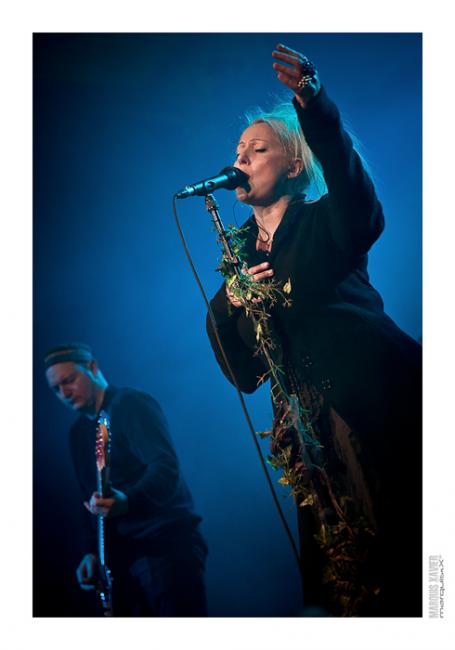 Phil : Because of the
atmosphere. I immediately felt a harmony between our music and the lyrics
of Isabelle. And also with the title she had chosen for the record ('Under
The Falling Stars'). Imagine that this boat stranded on an evening, under a sky
full of stars. Don’t we all hide a dark side and a certain disgust under a
beautiful appearance?
Phil : Because of the
atmosphere. I immediately felt a harmony between our music and the lyrics
of Isabelle. And also with the title she had chosen for the record ('Under
The Falling Stars'). Imagine that this boat stranded on an evening, under a sky
full of stars. Don’t we all hide a dark side and a certain disgust under a
beautiful appearance? You
also release a limited edition of the record on vinyl, next to the CD. Unfortunately,
it will contain only 8 out of 11 numbers due to lack of space. Why this choice?
You
also release a limited edition of the record on vinyl, next to the CD. Unfortunately,
it will contain only 8 out of 11 numbers due to lack of space. Why this choice?


